



A greasy shine on the wheel has two causes, not one
One question lands in our chat again and again, almost word for word: whether a steering wheel can be brought back so it stops looking greasy. It's nearly always the same picture behind it. The leather has gone dark, it shines at the ten and two o'clock spots, and it feels slicker under your hand than it should. What most people don't know: if you want to clean your leather steering wheel, you're actually facing two completely different kinds of damage.
A leather steering wheel shines either because skin oils have filled in the grain, or because the grain has been physically worn flat. The first you can clean away, the second you can't. Check which one you have first and you save yourself two hours of pointless work.
In high summer your wheel works against its own top coat
A steering wheel is the hardest-worked surface in the whole car, and in July two things join the hand sweat and skin oils that play no part the rest of the year. Sunscreen and hand sanitiser attack exactly the layer that protects the leather.
Modern sunscreens carry organic UV filters like octocrylene alongside solvents and water-resistant carriers. Those migrate into the clear coat on the leather and act as plasticisers there. The coat swells and softens, and in that state it is far more vulnerable to any rubbing than usual. Two weeks of holiday driving with creamed hands does more than half a year of normal use.
Hand sanitiser works differently and faster. It is mostly ethanol or isopropanol, and those alcohols break the ester bonds in the polyurethane outright. What's left afterwards isn't a weakened protective layer, it's an exposed pigment layer. If you routinely grab the dispenser after filling up and then take the wheel, you're wearing it out without noticing.
Then there's the factor almost nobody thinks about when they clean a leather steering wheel: hygiene. A comparative study by Queen Mary University in London found up to 700 bacteria per square inch on an average car steering wheel, Bacillus cereus among them. A public toilet seat came in at around 80. The reason is obvious once you know that 42 percent of drivers regularly eat in the car.
In practice that means summer is the season when a wheel ages fastest and the season it gets worked on least. Most people doing an interior round in July and August get through the dash, the glass and the mats and skip the one surface they hold for eight hours a week. A rainy day, when nothing works outside anyway, is a better slot for this job than a sunny Sunday at 30 degrees.
Why fine grain turns into a mirror surface
A leather steering wheel is built from three layers, and only the top one decides how it looks and grips. Underneath sits the tanned hide with its collagen fibre network, above that the sprayed-on pigment layer, and right on top the finish made from water-based polyurethane dispersions.
That top layer is microscopically rough when new. It has a grain with tiny peaks and valleys, and that scatters incoming light in every direction. Which is exactly why a new wheel reads matte and deep in colour. Lose the scattering and the diffuse reflection turns directional, and the surface starts to mirror. That's the greasy shine everyone describes.
The first cause behind it is reversible. Your hand transfers water, salts and lactic acid on every drive, plus lipids like squalene and free fatty acids. Those fats settle into the valleys of the grain and fill them up over time. What you end up with is a physically flat plane sitting on an intact protective layer. The right cleaner pulls it back out.
The second cause isn't. Over tens of thousands of kilometres hands slide across the same rim, and that micro-abrasion physically shaves the peaks off the grain. It's accelerated by any chemical softening, which is to say by the sunscreen from the section above. The surface gets literally polished flat. What's missing is material, and no cleaner brings material back.
Both causes usually show up on the same wheel, just weighted differently. A three-year-old car with 40,000 kilometres carries almost pure build-up, a ten-year-old with 200,000 mostly wear. In between sits the range where cleaning still helps but no longer brings everything back. Which is why diagnosing before you work isn't a formality: it decides whether a cleaner or a colour system ends up in your basket.

A taped-off test patch tells you what is still possible
Before any product touches the wheel, tape off a palm-sized area with masking tape on a heavily worn spot and clean only that. Leave the rest alone. Once the tape comes off, the direct comparison shows you which of the two you're dealing with.
If the taped patch comes up matte and dull with visible structure again, it was build-up. The finish is intact and the whole rest of the wheel will come back the same way. If the patch stays dark and shiny after a thorough clean and feels almost glassy, the grain is mechanically gone. More cleaning does nothing; colour restoration is next.
A second signal comes off the cloth. If the leather's own colour shows up on a light cotton cloth as you wipe gently, the clear protective layer is already gone and the pigment layer is bare. Same goes for sticky leather syndrome: if the wheel stays permanently tacky even when dry, the polyurethane has broken down through hydrolysis and only a sanding pad, leather cleaning spirit, leather dye and a sealant will save it.
With build-up the run looks like this: the wheel has to be cold, never work in the sun, rinse water at 35 degrees maximum. Never spray the cleaner on straight, foam it up and put the foam on the brush instead, otherwise moisture pulls through the seams into the foam padding underneath. Twenty to thirty seconds of dwell, never let it dry on, take it off with a damp cloth.
The brush isn't a side detail here. Soft natural bristles in pale horsehair lift the dirt out of the grain without marking the finish. Synthetic bristles are often too hard for this and leave fine scratches on an already weakened layer. If the top coat is visibly compromised or the car is very old, a soft leather sponge replaces the brush entirely. It needs more passes for the same result and risks nothing.
Which cleaners and conditioners belong on a wheel at all
The pH decides whether a cleaner looks after the leather or takes it apart. Car leather sits at pH 4.5 to 5.5 from tanning, and the safe working range is 5.5 up to 8.3 at most. Anything above that attacks.
That rules out the most obvious bottle on the shelf. All-purpose cleaners sit between pH 11 and 13, and that alkalinity splits the peptide bonds in the collagen and breaks down the polyurethane finish. The leather dries out deep, goes hard and grey and cracks. A leather cleaner isn't a category you can skip because there's already an interior cleaner in the car.
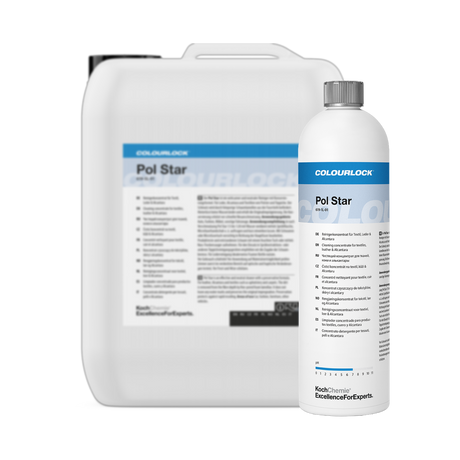
For day-to-day use a pH-neutral concentrate is the most economical call. The COLOURLOCK Pol Star cleaning concentrate sits at pH 7 and goes 1:20 with distilled water on leather, 1:10 for upholstery and Alcantara. One litre turns into up to 21 litres of working solution, and a mixed batch holds for about seven days before the surfactants tail off. Tap water leaves lime marks as it dries, so distilled.
If you'd rather work ready-mixed, take the COLOURLOCK Leather Cleaner Mild at a slightly acidic pH around 5.5, closest to the leather's own environment.
For the aftercare on a wheel a different property matters than on a seat: it has to stay matte. The COLOURLOCK Leather Shield soaks in and builds a dull, grippy sacrificial layer against friction, and the COLOURLOCK Leather Care smooth leather lotion adds the UV protection. On leather from about three years old, the COLOURLOCK Smooth Leather Care Set takes the choice off your hands entirely.
Worth being straight about the limits. A pH-neutral concentrate like Pol Star is made for textile, Alcantara and surface-pigmented smooth leather, and not for open-pore anilines or naps like nubuck and suede. And none of these products brings worn grain back, however often you apply it. When you clean a leather steering wheel the cleaner is half the job; the other half is knowing when cleaning is no longer the right tool.

These five moves finish off a leather wheel for good
The costliest mistake is the one forums push hardest: the melamine foam eraser. Microscopically it works like 3000 to 5000 grit sandpaper and takes the finish off layer by layer.
It looks great for the first few minutes because the shine is gone straight away. Except it's gone because the shiny protective layer got sanded off, not because the dirt came out. A week or two later that spot is rough, picks up new dirt twice as fast and can only be saved by re-dyeing. Same story with saddle soap, which is made for tough unpigmented riding saddles and, with its alkaline profile, breaks down the fine polyurethane on car leather.
The third mistake is wetness. Spray the cleaner on as a liquid instead of foaming it and water pulls through pores and decorative seams into the depth, the leather swells from the inside and shrinks hard as it dries. The fourth is too much pressure. A pale horsehair brush works on its own weight alone, without the hand pushing down, and three or four gentle passes pull more out than one hard one.
The fifth is the dangerous one, because it feels good. Classic leather greases, petroleum jelly and oil-heavy conditioning milks make the leather soft and glossy and leave a slippery film doing it. On a seat that's taste; on a wheel it's a safety problem: grip drops, and in an emergency swerve your hand slides. Whatever goes on a wheel has to soak in matte and leave no layer.
What's notable is that three of those five share one root: impatience. The eraser, the hard pressure and the liquid-sprayed cleaner are all attempts to do in one pass what three calm passes handle. Leather forgives repetition but not force. Give a wheel twenty minutes instead of five and you're not working more thoroughly, you're simply working with less risk.
Matte protects better than glossy, and measurably so
After cleaning the leather is clean but unprotected. The pores are open, the pH needs neutralising and the protective layer rebuilding, otherwise the next layer of grease sits there faster than before.
UV radiation acts as a bleach here, oxidising the pigments and making the material brittle. How well a protectant works against that is measured on the Blue Wool Scale, and from grade 6 the lightfastness counts as very good. Well-formulated UV filters hold back well over 90 percent of the radiation, but only as long as the layer is there. In a car that means renewing every three to six months, on a wheel towards the lower end.
The difference between matte and glossy isn't a matter of taste here, it's a material question. A matte sacrificial layer takes the friction that would otherwise hit the finish, and gets worn away itself in the process. That's the whole point of it. A glossy grease film just lies on top, closes the pores and pushes the actual problem one care cycle further out. Two years of the wrong product and the same wheel is back, only with less substance left.
On an Alcantara wheel almost none of this applies. Alcantara isn't a nap leather, it's a fully synthetic microfibre made of polyester and polyurethane, and brush plus pressure tear the hair-fine fibres off, which causes pilling.
You clean it with a heavily diluted pH-neutral cleaner as foam and take it off along the fibre direction with very little pressure. No leather conditioner goes on afterwards, because it glues the microfibres into a hard crust. How that runs in detail is in the piece on cleaning Alcantara without ruining the nap.
And if you're unsure which material is even fitted to your wheel: pigmented smooth leather is the normal case, Nappa turns up in high-end specs, Alcantara in sporty ones and PU synthetic leather in base trims. That distinction changes the product choice completely, and the piece on identifying your leather type and picking the right cleaner walks you through it step by step.

Detailing1 tip from the shop: We always run two separate cloths on a wheel, and that's not tidiness for its own sake. Carry cleaner and conditioner in the same cloth and you drag traces of one into the other at every swap, and you get shine islands that only show up as it dries. On a test car with a six-year-old wheel that cost us a full second pass. And plan the job for a day when you can leave the car standing for two hours afterwards. The leather needs that time to dry through before the conditioner goes on, otherwise it sits there as a streak on a damp fibre.
No time for the whole post? Get it summarized: