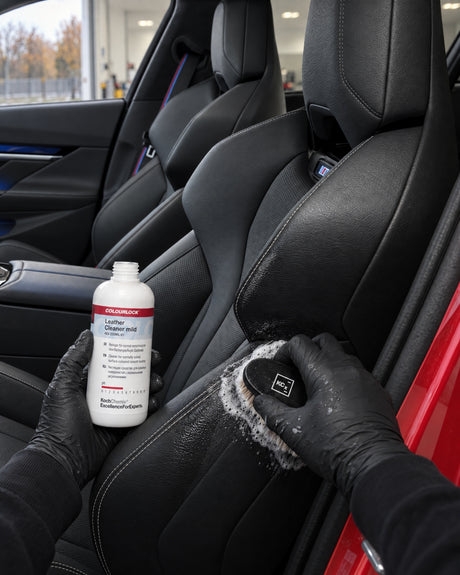
Caring for BMW leather starts with knowing whether it's Dakota, Vernasca or Merino
Daniel von Detailing1 |


Koch-Chemie
Protector-Wax "Pw" Preservation Wax
Wet sealant with lotus effect and layer build-up after every wash
Koch-Chemie
Hydro Foam Sealant "S0.03" Wet-Coat Sealant Concentrate
Optimal hydrophobic protection and deep shine for your vehicle


GYEON
GYEON Q²M WetCoat – SiO₂ wet sealant directly after washing
Koch-Chemie
WetGloss "Wg" Wet Coat Sealant for Extra Gloss and Strong Hydrophobicity
RTU Wet Sealant with Aminosilane for Gloss and Beading in Minutes


INNOVACAR
Hydrophobic Wet Sealant for Shine and Protection


CarPro
"HydrO2 Lite" Silica Spray Sealant
Simple solution for quick car care with instant shine
D-CON
Lightning-Wet-Coat Wet Sealant
Instant shine and hydrophobicity

SONAX
PROFILINE HyperCoat wet sealant
HyperCoat — Wet Sealant for Post-Wash Shine


CarPro
"HydrO2" Silica Spray Sealant — Wet Coat Sealant
Quick and easy to a gleaming vehicle
ZviZZer
Spray sealant for wet paint with strong beading


Koch-Chemie
Ceramic Effect Polish "Cep" Foam Polish
Brush-activated foam polish with hydrophobic protection for car washes


Meguiars
Deluxe Car Care Kit V2 Care Set
Complete set for laundry, paint protection, rims, tires & windows
What does a rinse-off sealant add to a car wash? It tops up the cleaning with water-repellent protection: you apply it to the washed, still-wet car and rinse it off as the manufacturer specifies. Ready-to-use sprays and dilutable concentrates suit different kit and different care routines.
Rinse-off sealants are paint protection you apply to the still-wet car after the wash. The treated surface turns hydrophobic, i.e. water-repellent: water forms droplets and runs off more easily. You'll also find these products sold as Wet Coat. The term describes the method – application with water; which surfaces you can treat and how long the protection lasts depends on the individual product.
Detailing1's tip from the shop: One question we get all the time at Detailing1 is how to dilute a concentrate in a foam lance. With a foam cannon on a pressure washer, extra water gets mixed into whatever is in the bottle. For Hydro Foam Sealant "S0.03", Koch-Chemie gives 1:50 to 1:150 in a foam sprayer or pump sprayer, but asks for an adjusted pre-dilution in foam cannons. So with every concentrate, check which piece of kit the mixing ratio is meant for.
Spray-on, rinse-off protection fits neatly into a hand wash, because the cleaned car can stay wet and only gets dried after the treatment.
After the wash you've got rinse water on hand anyway. That's exactly where this method comes in: the sealant gets its own step inside the wash. You don't need a separate dry application over the whole car. Cleaning and the final dry are still part of the job, though. A protective layer won't make a dirty car clean.
Two terms describe what you see. Beading means water forming droplets on the surface, sheeting means water running off in a sheet. Both help you read how the surface behaves while rinsing. Neither means all the water disappears on its own. Droplets can sit on horizontal panels, which is why the manufacturers covered here still want you to dry the car after sealing.
"Wet" describes the application, not a single chemical formula. A preservation wax applied wet can fall into the same application category as a ready-to-use Wet Coat. That tells you nothing about matching durability or matching dosage. What counts is whether the specific product suits your surface, the protection already on the car and the setup at your wash bay.
This also helps when reading product names. Words like "ceramic" in search results don't tell you on their own whether a product gets rinsed off, buffed off or left to cure. The application instructions decide. So don't treat a spray-on product used after the wash as a curing ceramic coating, and don't follow a coating's instructions with it.
If you're still choosing between the basic types of protection, the Lacquer sealing overview takes you further. Here it's about the choice within the wet wash routine: spray straight from the bottle, mix up a concentrate, or lay down a product made for it with a foam sprayer. Those questions shape your day-to-day routine more than a similar-sounding product name.
Ready-to-use sprays, concentrates and foam products differ in prep and kit – and a concentrate can also be designed to go on as foam.
The labels describe different properties and don't rule each other out. Ready-to-use means you don't add water before applying. Concentrate means a set dilution is required. Foam, on the other hand, describes how you spread the product. And "preservation wax" alone doesn't tell you whether the product goes on dry or wet.
| Format | Fits your routine if | What matters |
|---|---|---|
| Ready-to-use spray | you want to add protection without mixing anything. | Check consumption and approved surfaces; a spray head doesn't replace a jet of water for rinsing. |
| Concentrate for diluting | you want to work with a measured mix and a suitable sprayer. | The dilution has to belong to the product and to the kit you use. |
| Product suitable for foam application | you use an approved foam sprayer or a foam cannon set up accordingly. | Factor in the kit and how much water it adds; visible foam is no measure of durability. |
A pump sprayer puts the mix you filled in straight onto the panel. A foam cannon on a pressure washer, by contrast, meters product from its bottle into the water flowing through. So a figure for the spray bottle doesn't automatically describe the concentration that actually hits the car. Check the kit requirement before you buy, not when you mix your first batch.
If you're after dilutable products, Rinse-off sealant concentrates takes you deeper. For targeted application as foam, head to Foam sealants. A product can rightly sit in both. Pick the subcategory by your workflow; the labels don't rank protection from weak to strong.
A bigger container changes neither the application nor the formula instructions of the product. Rinse-off sealants in canisters are therefore a question of how much you use and how you store it. With Koch-Chemie Hydro Foam Sealant and ProtectorWax, the mixed dilution shouldn't be kept. Plan the amount for the job at hand, even if you draw the concentrate from a larger container.
The right protection depends on your water supply, approved surfaces and any existing coating – before consumption figures or expected durability can tip the balance.
First check whether you can rinse the product off completely after applying it. A bucket of water or a damp towel doesn't automatically replace the water jet the manufacturer has in mind. If you have no way to rinse like that, you need a product with a different application. The method should match what's actually possible at your wash bay; instructions you can't follow don't become suitable just because you dose sparingly.
| Your situation | Suitable method | Check before choosing |
|---|---|---|
| Hand wash with a proper water jet | Protection on wet paint, followed by a rinse. | Does the specific product call for a pressure washer? |
| Clean car with no further way to rinse | Suitable Spray sealants spread with a towel. | Are they approved for your dry or damp surface? |
| Existing ceramic coating | Protection explicitly suited to it. | Do the approval and the care instructions of the existing coating line up? |
On top of the water supply comes the surface. Paint, wheels, plastic and glass can need different approvals. For Hydro Foam Sealant, Koch-Chemie lists paint, glass and exterior plastic; that doesn't give a blanket approval for any other product. On a wrapped car or one with matte paint, you need explicit suitability for that surface.
Consumption, too, only makes sense alongside the state the product is used in. The millilitre figure for a ready-to-use spray can't be compared directly with the amount of a concentrate that still gets water added. Less concentrate doesn't automatically mean more effect. What counts is the specified dilution, the area wetted and the process the figure was given for in the first place.
So you can't spot the best rinse-off sealant for your routine from a long durability claim alone. If you want to work without a mixing container, that points to a ready-to-use product. If you want to fill your sprayer with a working solution, a concentrate made for it is the fit. Compare the actual instructions and approved surfaces.
Clean, cool, still-wet panels allow proper application, while correct dosing, rinsing on time and thorough drying help you avoid streaks and water spots.
Wash and rinse clean: Remove dirt with a pre-wash and hand wash that suit the car. Rinse off the cleaning products before you apply protection. A suitable Car shampoo is part of the cleaning; the sealant that follows doesn't do that job. Also check the panel for remaining contamination instead of covering visible dirt with a care product.
Prep the surface and kit: The paint has to be wet and must not be hot. Work so that you can rinse the product off at any time. Mix a concentrate as specified for your kit; a ready-to-use product stays undiluted. A matching Foam Sprayer only makes sense if the manufacturer intends that application method for the product you've chosen.
Apply and react accordingly: For Hydro Foam Sealant and ProtectorWax, Koch-Chemie specifies a short dwell time. WetGloss gets rinsed off thoroughly with a jet of water right after spraying. That doesn't add up to a general waiting time for the whole category. Never let the product dry on, and stick to its own instructions.
Rinse thoroughly and dry: Remove the product with the specified water jet; for manual use, ProtectorWax explicitly calls for a pressure washer. Then dry off the remaining droplets with a suitable, clean drying towel. Beading doesn't make this step redundant. Standing droplets in particular can leave visible water spots once they evaporate.
If you see streaks after application, first check dosage, temperature and when you rinsed. More product is not a targeted fix. Treat residue following the manufacturer's recommendation and check the result before applying protection again. The wet method also can't polish out scratches: paint defects call for proper paint correction, not another protective layer.
ProtectorWax, Hydro Foam Sealant and WetGloss differ in dosage, kit and approved surfaces, so choosing and using them depends on your actual wash routine.
Koch-Chemie Protector-Wax "Pw" is a preservation wax with a manual application described by the manufacturer. For that, the ProtectorWax data sheet quotes about 30 ml of product per litre of water. Dosing figures for car wash systems belong to a different process. For your hand wash, the manual figure is what counts, even though the product is also used in commercial wash systems.
Koch-Chemie Hydro Foam Sealant "S0.03" is aimed at anyone who wants a dilutable product for a foam sprayer or pump sprayer. The S0.03 product information lists paint, glass and exterior plastic. Its kit specs answer the key question for foam application.
Koch-Chemie WetGloss "Wg" is ready to use. In the WetGloss data sheet, Koch-Chemie quotes about 250 ml per car depending on vehicle size, and protection lasting several weeks. Those figures help you gauge how much you need without mixing up a working solution first.
A suitable protection product can top up an existing coating, but fresh beading alone proves neither the coating's original condition nor a longer life for the layer underneath.
A topper is an extra care layer on top of an existing sealant. Still, follow the care instructions of the existing coating, especially if it's freshly applied. A care product's approval doesn't replace the conditions under which the coating itself should be applied and maintained.
That doesn't mean you should top up after every single wash. Go by the instructions of the product you've chosen and by the protection that's already on the car. Let regular washing do its own job. Another care layer should be a deliberate call; it doesn't have to follow every hand wash by default.
If water runs off less well, the surface may first need a thorough clean that suits the existing protection. Extra product makes it harder to judge the layer underneath, because what you mainly see is how the freshly treated surface behaves. For that distinction, Coating care takes you straight to the right place.
If, on the other hand, you're after a standalone coating with its own prep and curing, the right choice is in Ceramic coatings. A Wet Coat does a different job in the wash routine. Choose it for the specific protection you want to add while washing, and judge the result by clean application and proper water repellency – not by lumping both methods together.
Too much choice in Rinse-off sealants? Get help picking:
Add Detailing1 as a preferred source on GoogleA wet sealant is a paint protection product that you apply to the vehicle while it is still wet after washing and then rinse off. A water-repellent film is left behind. Afterwards, you dry the car to prevent water spots from forming. The sealant does not replace thorough cleaning or polishing to remove paint scratches.
For Koch-Chemie Protector-Wax, a high-pressure cleaner is required for manual application. Koch-Chemie, on the other hand, mentions a water jet for thorough rinsing when using WetGloss. A standard garden hose is therefore not automatically suitable for every wet sealant. Before purchasing, check whether your equipment meets the manufacturer's specifications.
You spray a wet sealant onto the wet paint and rinse it off with water. A classic spray sealant is applied to clean, dry paint: you distribute it with a microfiber cloth and wipe off any excess. The deciding factor is therefore the prescribed method of application. This distinction does not indicate whether the product contains ceramic components.
Yes, if the product is approved for this purpose and the ceramic coating has completed its required curing time. Appropriate additional care can refresh the beading effect. In addition, follow the care instructions for your coating and clean the paint thoroughly beforehand. This will not recreate a ceramic layer that has already worn off.
Streaks can occur if the product dries out, is applied too generously, or is not rinsed off thoroughly. Hot paint and direct sunlight make application more difficult. Therefore, work on cool, wet surfaces and follow the product instructions. There is no standard dwell time for all wet sealants; follow the specifications for your specific product.
There is no fixed interval that applies to all wet sealants and vehicles. Follow the product instructions, your usage, and the condition of the cleaned surface. If the beading effect diminishes, wash the vehicle thoroughly before reapplying the sealant. For ceramic coatings, their specific care requirements also apply. It is not generally necessary to repeat the process with every wash.
Wash the vehicle thoroughly and rinse off any cleaning agents. Any remaining dirt must not be covered with protective care products.
Work on the still wet, cool vehicle. Keep a suitable rinsing method ready and do not treat hot surfaces.
Use ready-to-use products undiluted. Mix concentrates according to the specifications for the spray device being used; take into account the additional water admixture of a foam cannon.
Work according to the instructions for the chosen product. According to Koch-Chemie, Hydro Foam Sealant and ProtectorWax may dwell for a short time. WetGloss is rinsed off thoroughly with a water jet after spraying. Do not let any product dry on the surface; ProtectorWax requires the manual use of a high-pressure cleaner.
Dry the remaining water droplets with a suitable, clean drying towel. The water-repellent effect does not replace this step.
Daniel von Detailing1 |

Daniel von Detailing1 |

Daniel von Detailing1 |

Daniel von Detailing1 |

Daniel von Detailing1 |

Daniel von Detailing1 |

Daniel von Detailing1 |

Daniel von Detailing1 |

Daniel von Detailing1 |

Daniel von Detailing1 |

Daniel von Detailing1 |

Jasper von Detailing1 |