



Almost every alloy wheel is actually painted
There's one question that opens nearly every wheel conversation we have, and almost nobody can answer it on the spot: is your wheel painted, polished, powder-coated or diamond-cut? If you want to clean alloy wheels without dulling them, you answer that first. Because it decides whether the cleaner sitting on your shelf cleans your wheels or slowly ruins them.
The cleaner follows the finish, not the amount of dirt. Once you know which layer sits on top, you pick the right bottle in thirty seconds and save yourself white staining, dull spokes and, worst case, a wheel that is no longer legal to refurbish.
Alloy wheel does not mean bare aluminium
Practically every factory-fitted alloy wheel is fully sealed under a multi-layer paint system. So you are not cleaning a lump of metal, you are cleaning a painted surface.
Aluminium is a reactive light metal. The moment it meets air it grows its own protective oxide skin, but that passivation layer is just four nanometres thick and only chemically stable in a narrow window between pH 4.5 and 8.5. Anything below or above dissolves it. That is why primer, base coat and clear coat go on top of the aluminium, and that clear coat is the real sacrificial layer.
What that means for you: the same chemistry runs on the wheel as on the bonnet. Whatever you would not put on your body paint, you do not put on the wheel either. The only difference is that the wheel takes far more abuse, because it sits right next to the brake.
And that gets hot. Under heavy braking the disc surface hits 400 degrees Celsius, the iron particles fly off with more than two hundred degrees of residual heat and melt microscopically into the softer clear coat. Brake dust is sixty to seventy per cent iron oxides, the rest is graphite and metal traces. Leave it a week or two and it sits on top and comes off mildly. Leave it for months and the swelling iron oxide splits the paint structure and leaves craters no cleaner will ever close.
Five finishes and how to spot yours
The European market runs on five relevant wheel finishes, and you can tell them apart with no tools at all, just light and your fingertips.
The clear-coated alloy wheel is the factory standard. It looks even and smooth, and its reflection matches the body paint next to it. An old kerb scrape gives it away every time, because what shows underneath is a light primer, not bare metal. The powder-coated wheel lays down thicker and fuller, feels slightly more padded and is noticeably impact-resistant, which is why it usually ends up on winter sets. About forty-four per cent of all wheel coatings worldwide are powder today.
You spot the diamond-cut wheel by its two-tone look and by the fine concentric grooves under the clear coat on the mirrored face, almost like a vinyl record. Here the painted wheel went back on a lathe and had its face machined bare again. The chrome wheel, by contrast, has a deep blue-white shine, feels metallically cold even in summer and weighs noticeably more, roughly one to one and a half kilos per wheel. Its modern sister, the PVD finish, reads more of a bright silver-white, carries a clear coat on top and often shows a slight orange peel in the barrel.
That leaves the polished or anodised wheel with no top coat. It is rare, usually on older cars or aftermarket wheels, and it is the only case where you really do have bare metal in your hands. That case is the most fragile of the lot.
Two finishes deserve a warning of their own. On a diamond-cut wheel the clear coat does not sit on primer, it sits straight on mirror-smooth aluminium, and that bond is naturally weaker. Let a stone chip or a hairline crack from a tyre fitting break through the coat and moisture wicks underneath, chloride from road salt turns it into a galvanic cell, and corrosion spreads in a web under the layer. The trade calls it filiform corrosion, everyone else calls it blooming or white worms. That is why diamond-cut wheels count as unsuitable for winter.
Damage like that is not fixed with filler and a blow-in, because the groove pattern cannot be recreated by hand. The wheel has to be stripped, measured and re-cut on a CNC lathe, and Germany draws tight lines around that: the refurbishment guideline for light-alloy wheels in Verkehrsblatt issue 01/2023 allows cosmetic work only, caps damage depth in the aluminium at one millimetre, permits damage no further than fifty millimetres inboard from the rim flange, and allows exactly one refurbishment in a wheel's lifetime.
Chrome wheels have a winter problem of their own. Chrome is hard and by design tends to micro-cracking, where salt water settles in and eats the nickel layer underneath until the chrome skin flakes off. Genuinely chromed sets belong in the cellar before the first grit truck. PVD wheels, with their metal film only one to five micrometres thick, get through winter far better, because the clear coat above takes over as the barrier.

The pH value decides what the finish can take
When you clean alloy wheels, one single number decides the risk. Acidic cleaners below pH 5 tear inorganic dirt apart by dissolving the metal oxides outright. On intact clear coat that is manageable. On bare metal it is not.
Put an acidic cleaner on polished or anodised aluminium and it breaks through that four-nanometre oxide skin instantly and etches the metal underneath. You see it as dulling and a milky white staining that only comes out with a machine polisher. Add chloride from leftover road salt and you get pitting, which drives microscopic channels into the aluminium and never comes back. On chrome, the acid diffuses through the unavoidable micro-cracks down to the nickel layer and blows the chrome skin off from the inside.
How seriously that is meant is printed on our own labels. The TUGA Chemie Aluminium-Teufel® (Rot) sits at pH 0.55 to 1.0 and carries the signal word Danger, the GHS05 pictogram and hazard statement H290, may be corrosive to metals. The manufacturer prints the material risk on the bottle itself. That does not make it a bad product, it makes it a specialist tool for intact clear-coated steel and alloy wheels with genuinely baked-on brake dust, one to three minutes of dwell time and no colour indicator.
Alkaline cleaners from pH 8 up have a different problem. They saponify oil, grease and road film beautifully, but on a warm wheel or in the sun they flash off in seconds. The alkali then crystallises together with the dirt it just lifted and burns into the clear coat as a whitish haze that no second wash will pull back out. Anodised layers dissolve above pH 8 to 9 anyway. In between sits the band modern detailing chemistry works in, roughly pH 5.5 to 7.5, and there it lifts brake dust with chemistry that only targets iron rather than with brute force.
Cold wheel, three minutes, then rinse
The real trick with acid-free iron removers is that they need time and they need cool. Hardly anyone gives them either.
The active is a thioglycolate, usually sodium or ammonium mercaptoacetate. It works in two steps: first it gives up electrons and reduces the poorly soluble iron in oxidation state three to the more soluble state two, then it wraps around the iron ion like a clamp and locks it into a water-soluble complex. The new complex absorbs light differently from the starting material, and that is exactly why the foam turns violet. So the colour change is a reading, not marketing. If the foam stays clear, there is simply no reactive iron left on the surface.
For that reaction to run through, it needs three to five minutes and a temperature window of roughly ten to twenty-five degrees. On a wheel fresh off the motorway the water flashes off so fast that neat chemical stays behind and burns white edges into the clear coat.
Letting the wheels cool is therefore not a comfort step, it is the most important thing you do before the wash. If you park in the sun, move the car into the shade and wait the twenty minutes.
There is one move TUGA even prints on the canister, and almost nobody does it: after the first pass, turn the wheels through 180 degrees, so the valve rolls from top to bottom, and spray again. Only then do you reach the back of the spokes and the lower rim edge, where the brake dust sits thickest.
On sequence there is only one opinion in detailing: the wash always starts at the wheels and arches, never at the paint. When you rinse, a mix of dissolved iron particles and surfactants goes flying, and you do not want that landing on a door you have already cleaned.
Chemistry does not fully replace mechanics here either. It breaks the bond, but you still have to carry the dirt away, and you do that with a long-pile wool mitt or a soft wheel brush. Cotton cloths, kitchen sponges and stiff plastic brushes put micro-scratches into the clear coat that dirt will cling to even better next time.

What sits on our shelf and what it is for
Our range runs to thirty-three wheel cleaners. Four of them cover the cases that actually come up day to day, and they differ less in the result than in the question of which finish they tolerate.
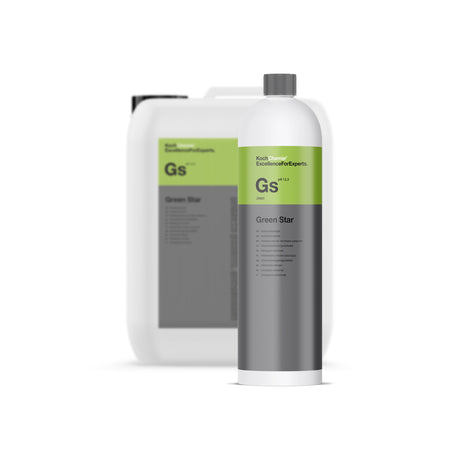
The TUGA Chemie Alu-Teufel "Spezial"® (Grün) in 1000 ml / 1 Liter is what we suggest when somebody does not know what they have. It is acid-free, sits at pH 7.0 to 8.0 and is released for aluminium, chrome, anodised, diamond-cut and powder-coated finishes. Its sodium mercaptoacetate turns the gel from greenish to red-violet as it works, and the xanthan in the recipe keeps it clinging to vertical spokes.
On high-gloss polished wheels TUGA themselves ask for a compatibility test in a hidden spot, and that sentence is worth taking seriously. Bare, uncoated metal gets no blanket release, not even from an acid-free gel. Test first, then do the whole wheel.
In the GTÜ comparison tests run by Auto Bild in 2016 and 2019 it took joint second place twice. Nine verified reviews sit at Trusted Shops, and customers consistently describe the wheel coming clean in about two minutes. It does not touch bitumen or tar, for that you need a solvent product.
The NIGRIN "Alu Monster" in 1000 ml / 1 Liter is the alternative when sensors are involved. It also works acid-free at pH 5.3 to 5.5 with sodium mercaptoacetate and is additionally released for wheels with TPMS sensors and ceramic coatings. It belongs on a warm wheel just as little as any other gel in this class. The Koch-Chemie Reactive Rust Remover "Rrr" in 500ml covers the case where it is not only the wheel carrying iron fallout but the paint and glass too. At pH 7.5 it stays neutral enough to run everywhere, and you skip the material research beforehand.
The TUGA Chemie Aluminium-Teufel® (Rot) mentioned earlier stays the emergency bottle on the shelf, not the weekly routine. When a winter set has sat unwashed in the cellar for two seasons and the spokes are speckled brown, it is the right answer. On a diamond-cut or polished wheel it is the wrong one. If you want the full overview, it is in our wheel cleaner category, and we wrote up the chemistry behind the categories in detail in choosing the right wheel cleaner.
If you do not know, take the acid-free one
The working rule for cleaning alloy wheels is short enough for the driveway: when in doubt, acid-free, cold, three minutes, rinse properly.
If you run a factory wheel and look after it regularly, you need nothing sharper than an acid-free gel. If you have diamond-cut, polished, anodised or chromed wheels, acid-free is not the easier option, it is the only one. If a neglected winter set is standing in front of you and you know for certain it is clear-coated and undamaged, the acidic cleaner can come out, but exactly once and with a short dwell. And if the wheels are freshly ceramic-coated, you only need a reactive cleaner every three to four months as a decontamination, because the surfactants and chelators will otherwise bleed the hydrophobic layer dry over time.
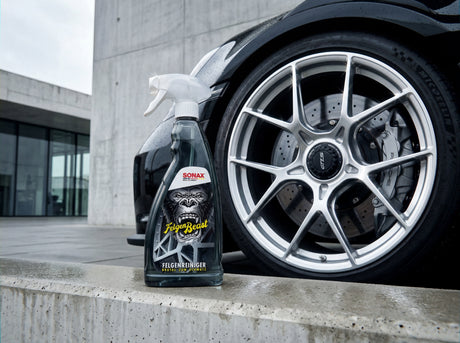
The second lever is prevention instead of rework. A smooth, protected surface takes brake dust far less readily, and what does not stick does not need dissolving. The SONAX XTREME Ceramic Reifen+FelgenDetailer in 750 ml lays a ceramic protective layer on tyre and wheel with its Si-Carbon technology, holds up to three months under normal conditions and needs neither dwell time nor rinsing. It only cleans light surface soiling though, so it is the step after the wash, not instead of it. If you want longer protection, the more durable options sit in the wheel sealant category, and which of them really stands up to heat is covered in sealing wheels against brake dust.
What you can safely skip are the home-remedy recipes from the internet. Oven spray is strongly alkaline, brake cleaner is a solvent with no iron chemistry at all, and on the wheel both hit exactly the layer you are trying to keep. Why baked-on brake dust shrugs them off is something we took apart in cleaning wheels with home remedies.

Detailing1 tip from the shop: When a customer at our showroom in Nordhorn does not know what wheel they are running, the first thing we look at is the oldest kerb scrape. If a light, matt primer shows underneath, the wheel is painted and you have all your options. If bare, silvery metal flashes out, it is diamond-cut or polished, and from there every acidic cleaner is off the table. We had a winter set in here whose faces looked flawless while the white threads of filiform corrosion were already running in the barrel. The owner had used an acidic cleaner for two years because he thought the wheel was painted. Thirty seconds of looking would have prevented it.
No time for the whole post? Get it summarized: