



A greasy film on the inside makes the windscreen fog up faster
You get in first thing in the morning, start the engine, and one breath later the windscreen has gone milky. The blower is roaring, you rub a gap clear with your sleeve, and two minutes later it's fogged up again. Your car is fogging up on the inside, and in October almost everyone knows the feeling. The usual answer is “set the ventilation up properly”, and that's right. But it skips a second cause that's sitting right in front of your eyes.
The glass fogs up when humid cabin air drops below its dew point on the cold glass. A greasy film on the inside gives the droplets something to cling to and makes the fog denser. Dry air plus streak-free clean glass keep your view clear.
In autumn your breath condenses on the cold glass
A car fogs up on the inside when warm, humid cabin air hits the colder glass of the windows and cools below its dew point there, so the water vapour drops out as tiny droplets.
The dew point is the temperature at which air can no longer hold its water vapour. In plain terms: the more humid the air in the car, the sooner the glass turns into a condensation surface. This morning the humidity in Nordhorn was 98 per cent, with 13 °C outside. A car that has cooled down overnight has glass at exactly that outside temperature. As soon as you get in and breathe, the humidity in the cabin goes up, and the glass is the coldest surface for miles around.
Then there's the small volume. A car cabin only holds about 2.5 to 3 cubic metres of air. Breathing calmly at 20 °C, one person gives off around 11 g of water vapour an hour, and a lot more in cold air. A wet jacket or a dripping umbrella easily brings 50 to 500 g of water in with you on every trip. What that means for you: two people and one drive in the rain are enough to push the air in the car to its limit.
That's why fogging is an autumn thing. In summer the glass is warm; in winter the outside air is so cold it carries little water and the heater dries the cabin quickly. In between come weeks of mild, damp mornings, wet jackets and umbrellas in the footwell. Search data shows it clearly: from the end of September, interest in “car fogging up inside” climbs every year and peaks in November.
The forecast for the next few days fits the picture. Rain is due from Thursday, almost non-stop until Sunday. Every rainy day brings water into the car, on shoes, clothes and umbrellas. Clean the inside of the glass and keep the car dry now, and you'll get through this week with a clear view. Put it off, and you'll be fighting the same five minutes with the blower every morning.
Dirt on the glass turns moisture into milky fog
A greasy film on the inside of the windscreen speeds up fogging, because water vapour settles more easily on grease, dust and residue than on clean, smooth glass and forms a dense, milky layer there.
It all comes down to the shape the water takes. On a greasy film, condensation pulls together into thousands of tiny droplets. Each one acts like a little lens and scatters the light, and that's exactly what we see as a milky haze. On clean glass the same moisture tends to spread out into a thin, even film of water that barely scatters the light at all. In practice: the clean windscreen stays see-through for longer, even though just as much water lands on it.
This film builds up all by itself. Over the months, dashboard plastics give off plasticisers, especially when the dash sits in the sun all summer. Car makers measure this outgassing to DIN 75201 and call it fogging: vapours from the cabin settle on the coldest surface, and that's the windscreen. For you that means even a non-smoker's car where nobody ever touches the glass ends up with a film.
On top of that come skin oils from fingers, residue from dashboard sprays, nicotine if you smoke, and a sticky glycerine film if you vape. In daylight you barely notice it. In low autumn sun or against oncoming lights at night it shows up as a grey veil that scatters headlights into starbursts.
A simple test that detailers love to show off proves how big the difference is. One half of the windscreen gets a thorough clean, the other stays as it is. Then steam goes into the cabin. The uncleaned side fogs up instantly and evenly. The cleaned side stays clear noticeably longer and, if it fogs at all, only along the bottom edge first. The humidity is the same on both sides. The difference is the glass.
That's the cause most tip lists leave out. Ventilation pulls moisture out of the air. It doesn't pull film off the glass. If your windscreen keeps fogging stubbornly even with the air con running, take a look at the inside in low sun. If you see smears, wipe marks or an even grey haze, cleaning is the quickest fix. How this film builds up and why it smears in summer is covered in our article on inside windscreen film.

Air con on and recirculation off clears the windscreen
The windscreen clears fastest with the air con on, recirculation off, the temperature turned up warm and the airflow aimed straight at the windscreen, because the air con pulls water out of the air.
Lots of people switch the air con off in autumn because they think it's only for cooling. But it's also a dehumidifier. The air flows over the cold evaporator, part of the water condenses there and drips out under the car.
What that means for you: the air that then hits the glass is drier and soaks up the fog instead of adding more. In older cars without air con the same principle works, just more slowly: temperature all the way up, blower on full, and the warm air dries the glass like a hairdryer.
The sequence that works fastest in real life: engine on, air con on, recirculation off, temperature to warm, blower up high, airflow to the windscreen. Many cars have a dedicated button with a windscreen symbol that sets all of this in one go. Switch on the heated rear window as well. If several people climb in with wet jackets, a short burst of full ventilation helps: crack the side windows open for a few seconds so the blower can push the damp air out.
The most common mistake is the recirculation button. On recirculation the same damp air keeps cycling through the cabin, and everyone keeps breathing more water into it. The windscreen then fogs up again and again, even with the blower running. Recirculation makes sense in a tunnel or stuck behind a tractor, but in damp autumn weather it costs you visibility.
The “warm or cold air?” question has a clear answer too. Cold air cools the glass further and just shifts the problem. Warm, dry air lifts the windscreen above the dew point and soaks up the moisture. So: warm and dry, meaning heat plus air con.
And legally: in Germany, Section 23(1) of the German Road Traffic Regulations (StVO) requires you to make sure your view isn't impaired by the condition of your vehicle. A peephole wiped clear isn't enough, and after an accident a German insurer can treat driving off with a fogged-up windscreen as gross negligence.
Glass cleaner and two cloths take the film off without streaks
An alcohol-based glass cleaner and two clean microfibre cloths remove the greasy film from the inside of the windscreen, as long as you spray the cleaner into the cloth rather than onto the glass and buff dry with the second cloth.
On the inside we use the TUGA Chemie Tugalin® "Glas-Teufel" Glass Cleaner. It's based on isopropanol and an ether alcohol and sits at pH 9 to 9.5. In plain terms: the alcohol dissolves grease and plasticisers, and the slightly alkaline pH cracks organic films like nicotine. What that means for you: the film comes off instead of getting smeared around. Tugalin is approved for tinted and filmed windows, but not for screens. For the infotainment and instrument display you need a dedicated screen cleaner.
You need less than most people think. 2 to 5 ml covers a square metre of glass. A windscreen is about one square metre, so two or three sprays per half of the screen. On the inside, spray it into the first cloth, not onto the glass.
Otherwise the mist ends up on the dashboard, in the speaker grille, in the camera area behind the rear-view mirror and, on cars with a head-up display, in the projector opening. Ammonia, found in a lot of household glass cleaners, attacks window tint film and, over time, the fine heating wires of the rear window. If you've got tint or just want to play it safe, grab the ammonia-free Meguiar's PERFECT CLARITY Glass Cleaner, which is made specifically with tint film in mind.
The cloth matters more for streaks than the cleaner does. The first cloth is damp and loosens, the second is dry and picks up. The GYEON Q²M GlassWipe EVO waffle-weave cloth, at 40 × 40 cm and 390 GSM, soaks up a lot of liquid with its waffle weave and makes a great working cloth.
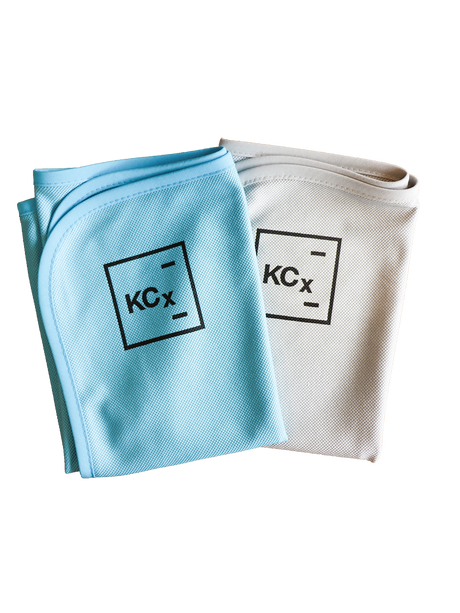
For the final buff, use a smooth, lint-free cloth like the Koch-Chemie Pro Glass Towel 230GSM Microfibre Glass Cloth, which comes as a pair. Wash both cloths without fabric softener, or you'll bring the next film straight back with you.
The technique: go round the edge of the glass first, then work the surface in a cross-hatch pattern. Make your last pass vertical on the inside and horizontal on the outside.
If you spot a streak later, its direction tells you straight away which side it's on. After applying, let the cleaner flash off for three to five seconds, then pick up the remaining moisture with the second cloth. You can reach the bottom corner of the windscreen from the passenger seat with your hand flat on the cloth, back of the hand facing up. For more on glass cleaners, check out our glass cleaner category, with matching cloths under glass cloths.

Sleeves, kitchen roll and too much cleaner smear the glass
Most streaks on the inside of the windscreen come from the tool, not the dirt: sleeves, gloves and kitchen roll spread grease around instead of picking it up, and too much cleaner dries into stripes.
The sleeve is the classic. The moment the glass fogs up, nearly everyone wipes a hole clear with their hand or sleeve. That helps for three seconds and leaves a greasy streak where the next fog sets in especially fast. Keep a clean, dry microfibre cloth in the glovebox in autumn and you can wipe the glass clear while parked without smearing it further. While you're driving, the ventilation is still the right way to go.
Kitchen roll and newspaper are next on the list. Paper leaves lint and is bad at picking up grease. A cloth that's already been used on the dashboard or with dashboard spray is just as unsuitable. Microfibre holds on to everything it has ever picked up and gives it back on the next wipe. Glass gets its own cloth, used for glass only.
Too much cleaner is mistake number three. Spray until the glass is wet and you saturate the cloth, so the dissolved film just gets pushed back and forth. Cleaning warm glass, say right after a drive with the heater on full, gets you the same result: the alcohol evaporates before the cloth can pick it up, and the surfactants dry into stripes. Give the glass a moment to cool down after driving.
There are loads of videos doing the rounds about home remedies like shaving foam or a potato. Both leave a film of surfactants or starch that makes droplets run together into a sheet of water. That helps for a bit, but against oncoming lights at night the film scatters the light, and starch dries milky.
A small bag of silica gel or cat litter in the footwell, on the other hand, is a sensible extra: it pulls moisture out of the air over several days. Ready-made anti-fog coatings work on this principle. On a big windscreen it's hard to get them on truly streak-free, and that's exactly what then bugs you every evening against the light. A clean windscreen is the more reliable foundation.
Wet floor mats keep the car damp for days
To stop the windscreen fogging up in the first place, the moisture has to get out of the car: dry wet floor mats, put wet jackets in the boot, keep drain channels clear and change the cabin filter on time.
The biggest source of water in autumn is the footwell. A wet shoe brings water onto the mat every time you get in, and a carpet mat holds on to it for days. Overnight it evaporates into the cabin and settles on the glass in the morning. Take wet mats out overnight, knock your shoes off before you get in, and put the wet jacket in the boot rather than on the back seat. Rubber mats are easier to keep dry in the rainy season.
If the windscreen fogs up all the time, even after a dry week, it's worth looking at the hardware. Right now in October, leaves pile up in the scuttle panel under the windscreen. If the drains there clog, rainwater rises up to the air intake and runs into the passenger footwell. Blocked sunroof drains or a loose door membrane have a similar effect.
Under the carpet sits a thick foam insulation layer that can hold a lot of water without the carpet feeling wet. A musty smell is the typical sign. A clogged cabin filter also slows the airflow, and many manufacturers specify a change every year or roughly every 15,000 km. The dealer swaps the filter at the service. No cleaner fixes these cases; they're a job for servicing.
For the glass itself: give it one thorough clean, then wipe it down regularly. In autumn a quick pass every two to three weeks with a little cleaner and the two cloths is enough. That way the film never gets the chance to build back up. At 2 to 5 ml per square metre, one litre of Tugalin covers a huge number of windows, well beyond a single season.
The outside has its own rules, especially now with rain on the way. We've rounded up the five most common causes of streaks on the outside in a separate article on streaks on the windscreen.

Detailing1 insight: When a customer asks why their windscreen fogs up even with the air con on, the first thing we suggest is looking at the inside against low sun. The densest grey haze almost always sits in the bottom strip by the dashboard, where the defrost air carries the fumes. That's exactly where most people wipe last. Tackle that wedge first from the passenger seat. And never use the cloth you've just used on the dashboard, or you'll bring the film right back in one swipe.
No time for the whole post? Get it summarized: