



Dual action or rotary decides what your clear coat looks like
"I'm looking for the right product in the polishing category, but I'm not sure." That message reaches us more often than any question about technique. Polishing itself isn't the hurdle, the choice beforehand is. It gets made long before you pick anything up, right at the drive type of the polisher. Grab the wrong one and you spend the rest of the day fighting your own tool.
Dual action and rotary machines move the pad in fundamentally different ways. Everything else follows from that: how fast defects disappear, how high your hologram risk is, and how much practice you need before the result holds up.
What a polisher actually does to your paint
A polisher uses a pad and an abrasive polish to remove a layer of clear coat only microns thick, dropping the surface down to the level of the deepest scratch. That is the whole trick.
The difference from working by hand isn't about comfort, it's physics. An abrasive polish needs friction and heat before its abrasives break down and start working. By hand you get neither, not across a panel. That's why a hand applicator handles wax and sealant just fine, but never real paint correction. This exact question lands in our chat regularly: whether a given product also works without a machine. With protection products, yes. With cutting compounds, no.
How much clear coat disappears is no small matter. On a factory finish the clear coat sits in the range of a few hundredths of a millimetre, and every correction pass costs you some of it. That's why the machine you pick decides more than convenience. It decides how much material you'll still have left for a second correction in five years.
And the timing is right. Google Trends puts demand for car polishing at its yearly peak in August, index 84.8 as a monthly average against 39.2 in January. Once a season's worth of bug splatter and water spots is on your paint, raking light shows you everything else too.
A dual action doesn't spin on its own
On a dual action the motor only drives the orbiting sideways movement. The extra rotation of the backing plate comes purely from centrifugal force, not from the gearbox.
That single fact explains nearly everything beginners run into with a DA. Because the rotation only tags along, it can also stop. Tilt the machine or lean on it too hard and the plate stalls. It keeps orbiting, but it barely polishes any more. That is exactly the safety net the dual action gets praised for, and at the same time the reason it feels slow to some people.
The rotary has no such buffer. Its plate turns rigidly on one axis, driven by the motor, holding its speed even under load. That gives you far more cut per minute, whether or not your technique is clean. It makes the rotary the tool for deep scratches, heavy oxidation and weathered clear coats.
It also makes it unforgiving. Dwell in one spot too long and you put heat into the paint; hold a wrong angle and you leave holograms, those arced hazes that read like wipe marks in raking light. A dual action forgives a lapse in concentration. A rotary writes it into the clear coat.
So the honest comparison looks like this. The dual action forgives mistakes and charges you time when the damage runs deep. The rotary delivers pace and asks for a steady hand and an eye on heat. Both get you to a very good result. Just not with the same effort and not with the same risk.
For your first hours on paint that means something concrete: on a dual action, the spinning plate is your feedback. As long as you can see it turning, the polish is working. When it stalls, you're just pushing foam around. You don't get that feedback from a rotary, where the plate turns regardless of whether you're doing it right. So the first question before you buy isn't which machine polishes better, it's which one shows you when you're making a mistake.

Throw and plate size tell you more than watts
The most important number on a dual action isn't power, it's throw: the diameter of the circle the plate describes alongside its own rotation.
In practice the classes sort themselves out neatly. A 21 mm throw on a 150 mm plate covers big panels in a few passes and is the fastest choice for roof, bonnet and doors. A 15 mm throw is the all-rounder that beginners and full-time detailers both work with, because it balances coverage against control. And 8 mm is the tool for edges, swage lines and bumpers, where a long throw simply stops sitting flat.
In between sits a third drive type that's missing from most comparisons: the forced rotation dual action. It combines the orbit of a DA with a rotation driven through the gearbox. The plate never stalls, not under pressure and not on an edge. That gives you DA safety at close to rotary cut. We have none of these in stock right now, so it stands here as context rather than a recommendation.
The backing plate matters too. A cushioned plate spreads pressure evenly across the pad, takes vibration out of the machine and keeps the polishing pattern calm, especially on curved panels. The FLEX Klett-Teller "Spezial" (Gedämpft) comes in 150 mm and 125 mm. Change plate size and you change pad size with it, and with that the effective pressure per square centimetre.
Cross hatch, heat and knowing when to stop
You polish in a cross hatch: horizontal passes across the section first, then vertical ones over the top, each pass overlapping the last by half a pad width.
Before any of that comes work no machine replaces. The paint has to be washed and decontaminated, otherwise you drag embedded particles across the surface as an abrasive and create exactly the scratches you set out to remove. Rubber seals, trim and matte black plastics get taped off, because polish soaks into porous surfaces and dries white in them. That quarter of an hour of prep decides more than the choice between dual action and rotary.
The sequence is the same for both drive types. Spread the polish evenly across the pad rather than dropping one blob in the middle. Set down at low speed and spread the polish before you wind it up, or you'll sling it off. Then work in small sections, half a bonnet rather than the whole panel. And stop when the polish goes clear. If it stays milky and matte, you used too much or lifted off too early.
Heat is both tool and risk here. A pad that warms up makes the paint more pliable and lets the abrasives do their job. A pad that gets hot burns polish and paint. On a dual action that's barely a concern; on a rotary it's the main job: keep moving, never dwell, check the panel with the back of your hand between passes.
Then there's the rule that makes the biggest difference: start with the least aggressive combination that could solve the job. Test whether a one step polish on a medium pad is enough. Only when a test section shows the defects surviving do you step up. That approach costs you fifteen minutes and saves clear coat you don't get back.

These three machines cover both principles
Three machines from our range, all in stock, cover the whole spread: two free spinning dual actions in different throw classes and one pure rotary.
The Rupes BigFoot "HLR21" iBrid Akku Exzenter-Poliermaschine Ø150mm runs a 21 mm throw on a 150 mm plate, which makes it the coverage machine of the three. The brushless motor runs up to 40 minutes on one 18 V 5 Ah battery, enough for one or two panels without a swap. Polishing cordless sounds like convenience, but it's mainly a precision gain: no cable dragging across the section you just finished.
The FLEX "XFE 2 15 18-EC" 15mm Akku-Exzenterpolierer mit Freilauf Ø150mm sits in the 15 mm class. Its free spinning drive adapts itself to pressure and curvature, which is what makes it so low on holograms. If you want one machine for everything, this is the class to shop in.
The FLEX "PE 2 18-EC" Akku-Rotationspolierer Ø150mm (18V) is the other side. Direct rotation, constant speed under load and a very flat gear head that gets you under spoiler edges and into wheel arches. It's the step up for anyone correcting deep defects in reasonable time who has heat under control.
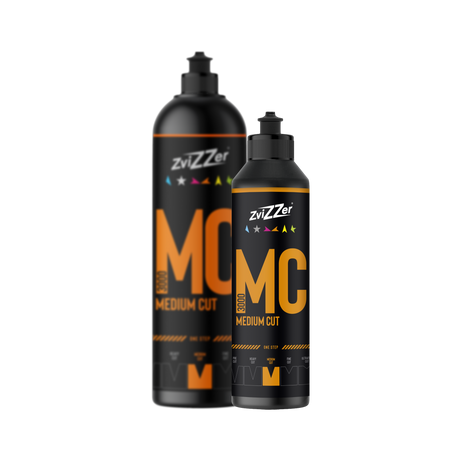
Two consumables make the difference in the result. The ZviZZer MC 3000 "Medium Cut" One-Step-Politur (Orange) removes defects from P3000 grit and finishes hologram free in the same pass, with one side of a car running around 30 minutes. The ZviZZer Thermo Trapez Pad "Medium" Thermo-Schaumpad (Orange) in open cell thermo foam lasts five to six times as long as a standard pad, because its structure lets the heat escape.
When a one step won't cut it, you go two stage. The Koch-Chemie Heavy Cut "H9.02" Grobe Schleifpolitur sits at cut 9.0 and gloss 6.0 and pulls out sanding marks down to P1200 grit, but leaves a finish that needs a second stage. That's the job of the Koch-Chemie Micro Cut "M3.02" Micro-Schleifpolitur, good to 3,000 grit. Both are silicone oil free, which counts when a ceramic coating follows. The full range sits in our Poliermaschinen and in the Politur category.
If you're unsure, take the dual action
For a first car of your own, and for anything that reads as wash marring and dull gloss, a free spinning dual action with a 15 mm throw is the right answer.
If you're working big panels regularly and time is the tight resource, go for 21 mm on a 150 mm plate. If your car is full of edges, swage lines and small faces, what you need on top is a short throw, not a different drive type. And if you correct deep scratches, weathering or overspray and you do it often, there's no way past a rotary, and no way past a second pass with a finishing polish afterwards.
Battery or mains is the one question that answers itself by workflow rather than skill. An 18 V 5 Ah pack carries the machines named here for up to 40 minutes, enough for one or two panels. If you correct a car in one go, plan for a second battery or take the corded version. If you work panel by panel at weekends, the battery buys you one thing above all: no cable dragging across the section you just finished.
For beginners caught between two paths there's a third answer that rarely gets said out loud: buy the machine you trust yourself with, and put the rest into the right pads and into light. A good lamp at a raking angle changes your result more than 200 extra watts, because you finally see what you're doing. How to read the defects beforehand is covered in our piece on polishing out scratches, and which polish belongs to which cut level is sorted in our guide to cutting compounds.
The fastest route to the wrong purchase, by the way, is hunting for the one best machine. There isn't one. There's only the machine that fits your paint condition, your time budget and your practice. Answer that honestly and you've already made the decision. Anyone trackside today, with the DTM weekend running in the Eifel, sees it on every pit car: they polish with both, depending on the job.

Detailing1-Insight: The most repeated beginner tip says to work a dual action with no pressure, as long as the plate keeps spinning. On a slightly curved bonnet that's exactly wrong. A 150 mm pad won't sit flat there, so you keep backing off pressure, hunting for an angle, and end up taking three times as long on the same panel. What we see day-to-day: people look for the fault in the product and order a more aggressive polish, when the problem was contact pressure. Work with the pressure the panel needs, and accept that the plate runs slower through a curve.
No time for the whole post? Get it summarized: