

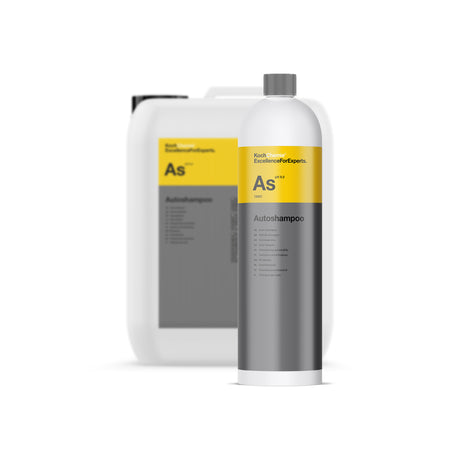


Water spots form fastest right now
You wash your car on a hot Saturday, rinse it down, turn around for a second to empty the bucket — and pale rings are already spreading across the bonnet. A question we get almost daily right now runs roughly like this: does this or that product actually stop water spots? The honest answer comes in two halves, and it has more to do with how hot your paint is than with whatever you're holding in your hand.
Removing water spots means one thing: dissolving the dried minerals from your tap water. As long as they're only sitting on top, a mild acidic quick detailer clears them in seconds. Let them bake in under heat and they turn into etching that only polishing takes out. This guide walks you through both cases — and how to head off the next spot while you're still washing.
Heat turns droplets into limescale rings in minutes
At 30 degrees in full sun, a water droplet dries on the paint in a few seconds, and that speed is exactly the problem. What's left behind isn't water — it's everything that was dissolved in it.
Over the coming days the highs around here climb to as much as 34 degrees, with a UV index of a good seven and not a drop of rain. A bonnet parked in the blazing sun hits 55 to 65 degrees surface temperature in no time. On metal that hot, your rinse water gets no chance to run off slowly — it evaporates right where it sits.
That's why water spots pile up at exactly this time of year. Google searches for removing water spots from a car jump every May and June and drop to zero in winter. That's no coincidence — it's the direct result of hot paint, hard water and the urge to wash the car yourself the moment the weather turns nice.
The key thing to grasp is the difference between dirt and a spot. A water spot is clean in the literal sense — there's no grime, just limescale. That's precisely why a normal re-wash with shampoo does nothing. You have to dissolve the minerals chemically, not clean the paint all over again.
And it isn't just the paint that gets hit. The same rings settle on the glass, on chrome trim and on glossy black plastic, where they stand out even more sharply against the light. If you're out there on the first properly hot wash weekend of the year, you'll often spot the effect for the first time in months — winter, with its cool, slow-drying panels, forgives a rushed rinse-off; high summer doesn't.
Why hard water leaves its mark on your clear coat
Tap water carries dissolved calcium and magnesium, measured in degrees of German hardness (°dH); the harder the water, the more visible the residue once the droplet has evaporated.
Across large parts of Germany the water hardness sits between 14 and 25 degrees of German hardness, which counts as hard. That means every litre carries several hundred milligrams of hardness minerals. As the droplet evaporates, those salts crystallise into a fine white-to-grey ring right at the edge where the drop last stood — the classic coffee-ring effect, only in limescale.
It pays to split this into two stages. The fresh water spot, type one, is a pure mineral deposit sitting on top of the clear coat. That one comes off chemically. The baked-in water spot, type two, is genuine etching: under serious heat the concentrated minerals and the leftover moisture have slightly attacked the clear coat and left a visible dip behind.
You can tell them apart with the fingernail test in raking light. If you feel a tiny edge and the spot stays visible even after a wipe with a bit of detailer, it's type two. If the spot shines evenly again once you've dissolved it, it was type one — and you got lucky by catching it early.
This is exactly where most pros sidestep the problem at the root: they give a final rinse with deionised water. With no limescale in the water, nothing can stay behind on the paint — the droplet dries spot-free. For a home wash that's often more hassle than it's worth, but it shows why the problem comes purely from the water and not from the paint itself. The harder your tap water, the stricter you have to be about drying.

Fresh water spots come off with chemistry, not pressure
Removing fresh water spots is a purely chemical job: as long as the spot is only sitting on the surface, a mild acid dissolves the limescale in under a minute — no polishing pressure, and no risk to the clear coat.
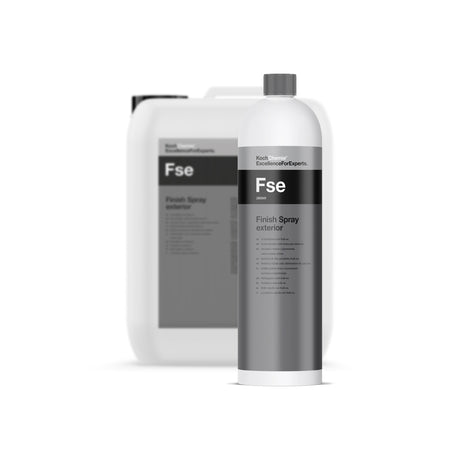
The right tool is an acidic quick detailer. The Koch-Chemie Finish Spray Exterior runs a Kalk-EX formula at a pH of around 2.5 and is built for exactly this: it converts the limescale crystals into a water-soluble form that you then simply wipe away. The key is that the panel has to be cool for it — so pull the car into the shade, check the metal with your hand, and only then spray.
The routine is short. Mist a thin layer onto the affected spot, let the product dwell for about 30 seconds and lift it off with a clean, plush microfibre cloth. Then go over it once with a dry side of the cloth, no pressure. For very light, really fresh hazing, a mild spray-on, wipe-off quick detailer is often all you need, without reaching for the acidic one at all.
The one thing you never do at this stage is scrub. Pressure drags the still-solid mineral crystals across the panel and pulls fine scratches into the clear coat. The chemistry does the work, your cloth only carries it away — and that order decides whether the spot ends up flawless or wiped dull.
Work in small sections as you go — half a door or a quarter of the bonnet at a time. That keeps the dwell time under control and stops the product drying on you before you lift it off, which is a very real risk in the heat. A nice side effect of the acidic detailers is that, on top of the limescale, they leave a thin slick layer behind, so the treated spot ends up noticeably smoother and glossier than it was before.
What belongs in your boot when it's hot
To fight water spots in summer you need three things: an acidic limescale remover for dried-on rings, a mild quick detailer for fresh hazing, and a sealant that makes the water bead off from the start.
The first job goes to the acidic quick detailer from the quick detailer category, which dissolves the limescale rings chemically. One litre stretches across a huge number of uses here, because you only mist a thin layer onto the affected spots rather than fogging the whole car — a single bottle easily sees you through the entire summer. If you look after several cars or work in a club, grab the big container straight away and decant into a handy spray bottle; the active concentration stays the same.
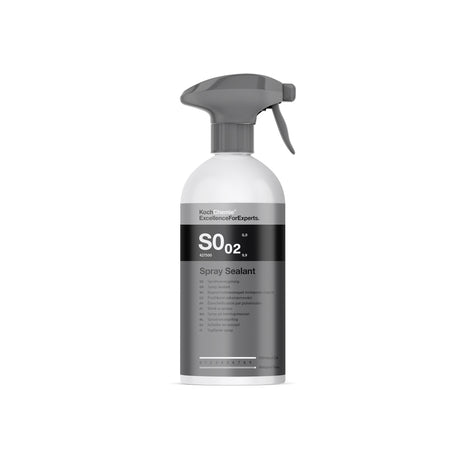
The second job is prevention, and over the long run it's the more important one. A spray sealant like the Spray Sealant makes the surface strongly hydrophobic. The water pulls itself into beads and sheets off in big runs instead of lying there as a film. Less standing water means fewer droplets that can dry on, and that means far fewer spots.
You have to stay honest about it, though: a spray sealant doesn't stop every spot. It shortens the contact time and makes drying easier, but it's no shield against a droplet that bakes in under the midday sun. If you want something more durable, take a look at the paint sealant range for a longer service life — the basic beading principle stays the same.

These mistakes are what really bake the spot in
Wash on hot paint, mess about with home remedies like vinegar, or rub it dry, and you'll quickly turn a harmless water spot into permanent etching in the clear coat.
The most common mistake happens before the actual problem: washing in blazing sun. On metal at 60 degrees the shampoo water dries faster than you can rinse it off, and you're making the spots at the very moment you're trying to wash them away. So the order is cool paint first, cleaner second — not the other way round.
The second classic is home remedies. The tip doing the rounds online is to dissolve water spots with vinegar or citric acid. That does actually shift limescale, but the concentration and pH are completely uncontrolled and it can attack the clear coat, rubber seals and bare trim. A purpose-built quick detailer is acidic enough for the limescale and mild enough for the paint — that balancing act is the whole point of the formula.
And there's an honest limit to any limescale remover: it takes off the mineral deposit, so type one. If the spot has already etched into the clear coat under heat, that's type two, and no spray will save it — the area then has to be levelled with a polish. Trying to force it with more and more acidic detailer just burns through product and irritates the seals without fixing the etching.
A third mistake is more subtle and happens while you're trying to do everything right: applying sealant to hot paint. Most spray products want cool panels, otherwise the carrier liquid flashes off before the protective film can lay down evenly, and you get streaks in exactly the shine you were trying to build. So the same ground rule applies here as with all summer care: get the temperature down first, then the product on.
You stop the next spot while you wash
A wash in the shade on cool paint, drying straight away and a hydrophobic sealant stop water spots more reliably than any remover you'd reach for afterwards.
Having to remove water spots at all is completely avoidable, and the most important lever costs nothing: timing. Early morning or late evening, when the paint is hand-warm rather than hot, pulls the ground out from under the whole problem. If there's no shaded spot to be had, it already helps to wash just one section at a time and dry it straight away, before the water evaporates on its own.
When it comes to drying, speed is everything. A big, thirsty drying towel that soaks the water up rather than shoving it around is worth more here than any polish afterwards. Lay a spray sealant on top after the wash and you couple two effects: the water beads off next time, and the little that does stay comes off in half the time.
Your drying technique matters too. Lay the towel flat on the wet panel and pull it in one direction without pressure, instead of rubbing in circles — that way you lift the water before it has time to dry on, and at the same time you dodge the fine wipe marks that show up so mercilessly in summer light. On a freshly sealed panel a single pull is often enough, because the water has already gathered into big beads and barely touches the paint any more.
If you want to go deeper into clean washing, you'll find the full method in our guide to swirl-free washing with two buckets. And if, on top of the water spots, there are still rough patches from early summer sitting on the paint, it's worth a look at the proper decontamination of fallout, tar and tree sap before you seal.

Detailing1-Insight: Out in front of our Showroom in Nordhorn, we always see water spots first on the dark panels and the bonnet, and only ever last on the doors. The reason is simple: the bonnet gets hottest in the sun, often over 60 degrees, and up there every droplet evaporates in two or three seconds. So on a test car we always do the bonnet and roof first and leave the cooler side panels for later. Go the other way and work top to bottom, and the bonnet is already full of fresh rings again before you reach the bottom.
No time for the whole post? Get it summarized: