
5 winter washing mistakes that keep road salt working
Last night it was minus three degrees in Nordhorn, the gritters are out, and every year around this time the same question comes up: should I even wash the car now, or wait until spring? The short answer is to wash it, just differently from summer. Most winter damage isn't caused by the washing itself but by five small mistakes along the way.
Washing your car in winter protects it from road salt if you wash on a day above freezing, loosen the salt with foam before anything touches the paint, include the wheels and wheel arches, dry the seals and finish the paint with a wet sealant.
1. Waiting until spring gives salt weeks to work
If you don't wash in winter, you give road salt weeks instead of days, because salt attacks metal faster as soon as it turns damp and mild, which means every time there's a thaw.
A research report from TU Wien (Vienna University of Technology) on winter road maintenance and corrosion puts it like this: corrosion from de-icing salt speeds up considerably as temperature and humidity rise. Under a layer of salt, steel starts to rust from around 33 per cent relative humidity. In plain terms, a grey salt haze on the sills isn't a cosmetic flaw but a damp film that keeps working on every mild day. In November, humidity in northern Germany is almost always well above that.
That's why the German motoring club ADAC recommends the same rhythm for washing your car in winter as in summer. It doesn't have to be a full wash with every step. Just rinsing the wheels, wheel arches and lower doors thoroughly takes most of the salt off before it settles into edges and seams. We showed how much salt collects behind the wheels in our post on the underbody wash before winter.
A rhythm that works: after every longer drive on gritted roads, give the car a proper rinse with clean water, and every two to three weeks do a full wash with a pre-wash. Google search data shows, by the way, that most people only start searching for winter car washing in January. Start now and you're a month ahead of the salt.
Where you wash matters less. In a self-service wash bay you hold the lance yourself and can aim straight at the wheel arches and sills. An automatic car wash with an underbody wash, on the other hand, rinses areas you can barely reach with the lance. Either way, all that matters is that the salt comes off a few days after the drive, not weeks later.
2. Without a pre-wash, salt in the mitt scratches
If you go straight at salty paint with a wash mitt, you push salt crystals and sand across the surface, and that leaves fine swirls under raking light that weren't there before.
Salt particles act like an abrasive, writes the German insurer HUK in its winter tips, and the ADAC explicitly advises not to skimp on the pre-wash. Winter dirt is different from summer dirt: it's heavy, gritty and clings as a film. A mitt rubbing over it picks up the grit and drags it across the next pass. Worth remembering: the scratches happen in the first two minutes, not at the end.
The fix is a touchless pre-wash. First rinse the car with clean water, then apply foam and let it dwell. Koch-Chemie Gentle Snow Foam "Gsf" 1000 ml / 1 litre works at pH 7.5, so it's neutral and won't attack a sealant either. In the foam lance, 20 millilitres per litre of water is enough. The foam clings to vertical panels for four to six minutes, binds the loose particles and takes them with it when you rinse.
Two details make the difference. The foam only goes onto wet, pre-rinsed paint, otherwise it grinds the grit in itself. And it goes on from the bottom up, while you rinse from the top down. In the cold it can stay on a little longer, but it must never dry on. The mitt only comes out once the water runs off clear. If you prefer the self-service wash bay, use the foam programme there and rinse twice as long as you would in summer.
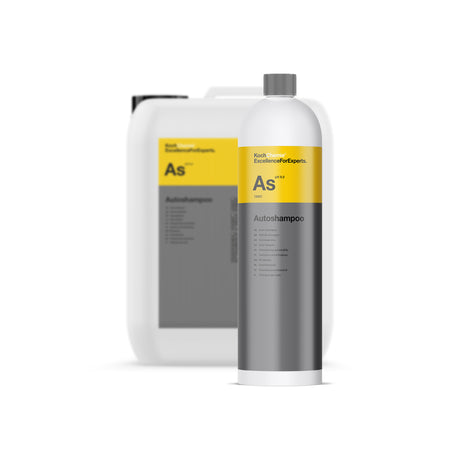
After the pre-wash comes the hand wash, and a simple trick helps here too: two buckets, one with shampoo and one with clean water and a grit guard at the bottom. Rinse the mitt in the clean bucket after every panel before it goes back into the shampoo. That way the salt ends up in the rinse water and not on the next door.

3. Salt lingers longest on wheels and wheel arches
Wheels and wheel arches catch the most salt water in winter because the tyres throw it straight at them, and there it mixes with brake dust into a grey film.
That film needs a dedicated wheel cleaner. Koch-Chemie Magic Wheel Cleaner "Mwc" 500 ml is acid-free and sits at pH 5 to 6. Its active ingredient reacts with the iron particles in the brake dust and turns them red-violet. For you, that means you can see where it's working and rinse exactly there afterwards. After two to five minutes the reaction is done. Waiting longer gets you nothing, because by then the active ingredient is saturated.
Winter actually brings an advantage here that a lot of people don't know about. The cleaner goes onto a cold, dry wheel, never onto hot brakes straight after a drive. So let the car stand for half an hour before you start. If there's a thick layer of salt and slush on the wheel, rinse it off with clean water first and let it drip off briefly. Then the cleaner hits the brake dust and not the slush on top of it.
Don't forget the plastic wheel arch liners either. Wet leaves and salty slush collect behind them and stay damp there for days. A strong jet of water from below shifts most of it without you having to take the liners off.
On heavily soiled wheels, two short rounds of three minutes each work better than one left on for ten minutes. Rinse out the wheel arches with a flat jet from front to back, and keep the wheel brush away from the paint. There's more on brushes and wheel zones in our post on baked-on brake dust before winter.
4. Parked wet, door seals freeze shut overnight
If you wash below freezing or park the car wet, you'll find frozen doors the next morning, because the water in the seals, door edges and locks turns to ice.
“Can you wash your car below freezing?” gets searched a lot every winter. The practical answer: you can, as long as you dry it afterwards, but a day above freezing is better. The ADAC advises not to go through an automatic car wash at all below minus ten degrees, because warm wash water on ice-cold metal causes sharp jumps in temperature. For the same reason, pouring hot water onto an iced-up windscreen causes stress cracks in the glass.
So after the wash comes a step hardly anyone bothers with in summer: open the doors, boot and fuel flap and dry the edges. A large, soft drying towel like the Koch-Chemie Pro Drying Towel 950GSM Grey / 50x80 cm soaks up a lot of water with its 950 grams of microfibre per square metre, without you having to press down. Dab the rubber seals first, then the sill plates, and finally the edges of the bonnet and tailgate.
Water often sits in the door locks, door handle recesses and fuel flap after a wash. Dab it out with a corner of the towel and open the fuel flap once so it doesn't freeze shut. On cars with Keyless entry, it's mainly the door handle recesses that matter.
Then take a short drive so the water runs out of the mirrors and trim strips, and open and close the doors a few times. If you looked after your seals before winter, you're at an advantage here. Our post on treating your door seals before the frost shows how. And if the windscreen still freezes over, our guide to de-icing without scratches will help.

5. Unprotected paint traps salt from the next drive
A freshly washed car without protection is just as grey again after the next drive on gritted roads, because salt water lies flat on bare paint and dries on there.
On a sealed surface, water pulls together into beads and runs off, taking some of the dissolved salt with it. You see the difference at the next wash: the haze rinses off almost completely with foam and clean water instead of sticking. The German inspection body TÜV Nord recommends protecting paint before winter. If you missed that, catch up now with a wet sealant, because it needs neither polishing nor warm weather to work it in.
Koch-Chemie Hydro Foam Sealant "S0.03" 1000 ml / 1 litre is a concentrate that you dilute at 1:50 to 1:150. It goes on straight after the wash while the car is still wet, with a foam sprayer or pump sprayer. After a short dwell time, rinse thoroughly with clean water and dry off the remaining water. The handy part: instead of standing in the cold with a polishing cloth for half an hour, you need about ten minutes.
How to tell the protection is fading: when water no longer beads during the wash but sits there as a film, it's time for the next round. In winter that happens after a few weeks depending on your mileage, sooner on the bonnet and front bumper than on the roof.
To be honest about it: a wet sealant doesn't replace a ceramic coating and doesn't last as long as a sealant built up carefully in warm conditions. For winter it's still the right choice, because you can top it up with every wash. If you already have a ceramic coating on the paint, use the wet sealant to refresh the surface between washes.
Four things are enough for a safe winter wash
You don't need a big range of products to avoid all five mistakes, just a pre-wash foam, a wheel cleaner, a wet sealant and a good drying towel, plus a day just above zero degrees.
Gentle Snow Foam "Gsf" takes care of the pre-wash. At 20 millilitres per lance fill, one litre is enough for around 50 pre-washes, so easily the whole winter. Its limit: against stubborn road film in late winter, an alkaline pre-cleaner works harder, but it also wears down a sealant faster. You'll find both options in our Pre-cleaner category. Important in winter: store all bottles somewhere frost-free, not in a cold boot.
Magic Wheel Cleaner "Mwc" handles the wheels. Its limit: it doesn't dissolve tar or oily residue, for that you need a tar remover. Hydro Foam Sealant "S0.03" protects the paint until the next wash, and the Pro Drying Towel dries seals and edges. All four come from Koch-Chemie and fit into a wash you can get done in just over an hour.
If you only have time for the essentials, washing your car in winter follows a simple order: rinse with clean water, foam, wheels, rinse, dry the seals. The hand wash with shampoo from our Car shampoo category and the sealant come on top when the weather gives you a calm afternoon above freezing.

Detailing1-Insight: What we see most often in winter isn't rust but swirls on the lower doors that only show up in the March sunshine. They almost always come from the first wash after a salty drive, when the mitt starts at the bottom of the door instead of up on the roof. Reverse the order: start at the top, and do the bottom 30 centimetres last with a separate mitt. That way most of the salt stays where it belongs anyway, in the waste water and not in the paint.
No time for the whole post? Get it summarized:
Add Detailing1 as a preferred source on Google