



Which microfibre cloth protects your paint from scratches
In June there's a yellow film on the bonnet every morning, and the first reflex is nearly always the same: a quick wipe with a cloth so you can see out again. That exact reflex is what puts most of the swirls into your paint — not the pollen itself, but the wrong cloth at the wrong moment. A microfibre cloth for your car isn't just any cloth, and the one you reach for decides a lot more than shine.
Microfibre cloths differ above all in their GSM value — the weight per square metre in grams. Low GSM means lint-free work on glass and coatings; high GSM means maximum absorbency for touch-free drying. This guide shows which value belongs to which step — and why the right cloth matters more in pollen season than any polish.
What really makes a microfibre cloth for your car
A microfibre cloth for your car is a weave of extremely fine synthetic fibres that pulls dirt and water into the gaps between its fibres instead of dragging them across the paint. A single fibre is often just one two-hundredth the thickness of a human hair — fine enough to reach into the microscopic pores of the clear coat and trap particles a cotton cloth only spreads around.
Quality lives in the blend. Good detailing cloths are around 70 to 80 percent polyester for structure and mechanical dirt release, and 20 to 30 percent polyamide for absorbency and softness. The polyamide is the part that feels soft and binds water; the polyester gives the fibre its structure. Without the polyamide, a cloth feels hard and pushes particles along rather than picking them up — the first, often invisible reason for scratches.
The second figure that counts is the weight per square metre, the GSM value. It describes how much fibre sits on a square metre, and with it how dense and plush the cloth is. A thin glass cloth at 300 g/m² and a fluffy drying towel at 950 g/m² are both microfibre, but they do completely different jobs. Mix them up and you'll dry with a linting all-rounder or clean glass with a heavy plush cloth that streaks.
The edge matters too. A good cloth has a soft, sewn-in border band or laser-cut, rounded corners. The hard stitched edge on cheap cloths is the most common hidden scratch-maker, because it scrapes across the paint while the soft face is already working clean. It's worth flipping a cloth over before you buy it and feeling the corners.
The difference from classic cloths sits exactly in that pick-up mechanism. A cotton cloth or a chamois pushes water and dirt ahead of itself like a wave, hard particles and all. Microfibre instead draws the liquid by capillary action into the thousands of fine gaps between the fibres and takes the dirt in with it, away from the paint surface. So what matters isn't whether a cloth is soft, but whether it traps particles or shoves them along — and that comes straight down to the fibre mix and the GSM value.
The GSM classes from glass cloth to twisted loop
The market sorts microfibre cloths into GSM classes, and each class has its job. Know the four bands and you'll never buy the wrong cloth again. The bands follow common detailing practice and line up with the fibre standards described industrially under DIN 61210 for textile fabrics.
In the 200 to 350 g/m² range sit the short-pile waffle and pearl-weave cloths. They absorb little but are extremely lint- and streak-free — ideal for windows, interior displays and wiping off fresh ceramic coating. They've no business on wet paint; their absorbency is too low, and a soaked waffle cloth streaks straightaway.
The 350 to 500 g/m² class is the all-purpose plush, the terry cloth. It offers the best balance of density and handling and is the cloth you use to buff off polish and wax or spread a maintenance spray. If you keep only one cloth in the car, this is it — versatile enough for almost any job except drying large panels.
Between 500 and 900 g/m² the ultra-soft, dual-pile plush begins. These cloths are very soft, lock dirt deep into the fibres and are the right call for working with a quick detailer or for a waterless wipe-down in between — anywhere the cloth is in direct contact with dirty paint and has to lock every particle away instead of pushing it.
Right at the top, from 1000 to over 1500 g/m², sit the twisted-loop and coral-fleece cloths. They're so fluffy and thirsty that they hold up to seven times their own weight in water. Their job is touch-free drying: you lay the heavy cloth flat, don't rub it, and let it lift the water film off through capillary action alone.

Clear coat is softer than the dust sitting on it
Why the right cloth decides the scratch question only clicks once you know the hardness figures. Modern car paint is a highly cross-linked two-component polyurethane system and sits on the Mohs scale somewhere between 2 and 4 — between gypsum and fluorite. Quartz dust, the main component of road and ambient dust, comes in at Mohs 7.
That's a huge gap. Harder scratches softer — that's the basic principle of the Mohs scale. Quartz even scratches window glass; on your clear coat, a scratch on unlubricated contact isn't a matter of bad luck but a physical certainty. The dust wins every time there's no water film in between to lift it and carry it away.
Pollen makes it worse. Under the microscope, pollen grains aren't smooth little spheres — they carry spikes and barbs on their outer shell that hook into surfaces. On the paint they mix with the crystalline quartz dust out of the air. Drag a dry cloth over the bonnet now and you press that mix into the soft clear coat like fine sandpaper. Circular motions turn it into the classic swirls — fine concentric scratches that scatter the light and visibly dull the shine.
In detailing forums this mistake keeps coming up as the duster myth: dust twenty seconds over dry paint in peak pollen season because you're short on time, and you carve in fine hairline scratches that show up as a cobweb in raking light. The consensus there is as blunt as it is right — no mechanical wash, no drying, it's like brushing your teeth without a brush. Even a good, soft cloth makes no exception for dry pollen dust.
The conclusion is uncomfortable but clear: the best microfibre cloth in the world will scratch dry, dirty paint. Fibre quality only decides how much — dry, it can't prevent it. That's why scratch-free work doesn't start with the cloth but with the water that dissolves the hard particles before a fibre ever touches them.
Loosen first, then lay the cloth on without scratches
The right cloth only earns its keep at the end of a chain that loosens the hard dirt first. The order matters more than any single product, and in pollen season it isn't up for debate.
Step one is the touch-free pre-wash. A pH-neutral pre-wash foam lays down thick on the paint, softens the pollen-and-dust film and rinses a large share of the hard particles away before any cloth touches the surface. The less quartz left on the paint after the pre-wash, the fewer grinding grains a cloth can pick up later. That's the decisive anti-scratch step most people skip.
Then comes the actual hand wash with plenty of lubrication. A wax-safe car shampoo builds a glide film in which the wash mitt floats over the paint instead of scraping. Work with two buckets — one with shampoo, one for rinsing out — and you don't tip the loosened dirt back onto the paint. How that works in detail is in our post on the two-bucket method.
Only now does the heavy cloth come in. You lay a twisted-loop drying towel flat on the wet paint and either draw it across with no pressure at all or just press it down and lift it off again — the pat-drying method. The cloth works through its absorbency, not through friction. A plush drying towel takes up the last water film without dragging it across the paint.

These cloths and their kit are on our shelf
The scratch-free routine doesn't need a dozen products, just four that work together. The drying towel is the core; around it stand the helpers that get the hard dirt off the paint before the cloth touches it.
The Koch-Chemie Pro Drying Towel is the centrepiece. At 950 g/m², 70 percent polyester and 30 percent polyamide, with a knitted construction and rounded corners, it sits right on the threshold of the twisted-loop class: thirsty enough for pat-drying, soft enough not to stress the paint after the wash. In a 50 by 80 centimetre format it dries a roof in a few passes.
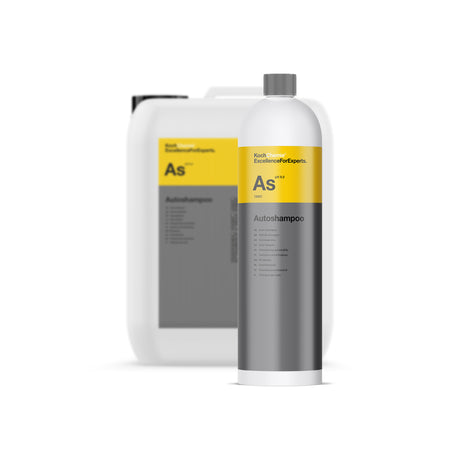
Ahead of it stands the Gentle Snow Foam, the pH-neutral pre-wash foam that softens the pollen film and rinses it off — wax- and coating-friendly, so it's no trouble even on well-kept paint. It's deliberately not made for baked-on bugs or tar; those are a job for active cleaners. The Autoshampoo As brings the glide film for the hand wash with its surfactant blend and looks after any existing wax and coatings; about a litre lasts around eight washes.
For a quick fix in between — a single sap spot, a fresh mark — there's the Fusso Coat Speed & Barrier Quick Detailer. Sprayed onto a 500-to-900 GSM plush cloth, it lifts light dirt with plenty of lubrication and leaves a hydrophobic protective film at the same time. The logic behind this in-between care is in our post on touch-free pre-washing. You'll find a wider choice in the microfibre cloths and drying towels categories.
Which cloth for which job
In the end it all comes down to one simple match-up: GSM value to task. Once that's second nature you reach for the right cloth on instinct — and that's the difference between paint that still glows deep after three years and one that shows a cobweb of swirls in raking light.
For drying after the wash, reach for a cloth from 950 g/m² up or a true twisted-loop over 1000 g/m² — laid on, not rubbed. For the pollen or sap spot in between, take a soft 500-to-900 GSM plush cloth with a quick detailer as lubricant and work in straight passes only, never in circles. For glass, displays and wiping off coating, the lint-free waffle cloth at 200 to 350 g/m² is the one.
In practice, for pollen season that means: better to wash properly once a week than to dry-wipe every day. A good drying towel like the 950 GSM Pro Drying Towel will stay with you for years if you look after it — washed separately from wheel cloths, at 40 degrees, no fabric softener. Measured against what a machine polish to remove swirls costs, the right cloth is by far the cheapest paint insurance you can buy.
And for the dirt still sitting hard and dry on the paint, no cloth is the answer — water is: foam first, loosen first, then lay the cloth on. Pollen doesn't wait politely, but it doesn't scratch on its own either — that only happens with the cloth you hand it without a water film.

Detailing1 insight: Something we see time and again: most people buy a good drying towel and use the same side over the whole car. But the moment the first layer of pollen sits in the pile, it travels along to the next panel. We fold the 50-by-80 towel into quarters and turn to a fresh side after every second pass — so saturated fibre with embedded quartz never lands on fresh paint. And a new towel goes through the wash once at 40 degrees without softener before its very first use, because softener clogs the fine capillaries and halves the absorbency.
No time for the whole post? Get it summarized:
Add Detailing1 as a preferred source on Google