















Car fogging up on the inside: why a clean windscreen stays clear for longer
Daniel von Detailing1 |


Koch-Chemie Alkali Wheel Cleaner "Awh" Wheel Cleaner (alkaline) - 5 liters is on backorder. As soon as everything in your order is back in stock, we ship it all in one go — delivery time follows whichever item takes longest.
— Order now, limited availability, delivery time 1-4 days
Item added to your cart.
View cart


| Koch-ChemieAlkali Wheel Cleaner "Awh" Wheel Cleaner (alkaline) 5 liters In stock (1 unit)
|
85,79€
Contents: 5lUnit price (17,16€
/ l)
Unavailable
|
||
| Koch-ChemieAlkali Wheel Cleaner "Awh" Wheel Cleaner (alkaline) 20 liters Pre-order
|
311,84€
Contents: 20lUnit price (15,59€
/ l)
Unavailable
|
Do you have any questions or need help?
We are sure that our help page will help you. There you will find information on how to contact us and the relevant answers to frequently asked questions.
Didn't find what you were looking for? Write us a message in the chat.
Shipping to Italy from 8,90 € with FedEx, DPD or SDA, delivery time 1-4 days.
All shipping methods, weight tiers and express options are listed in our shipping policy.
Car Care Store in Nordhorn
Why wait when you can get it fast? Order your car care products from us online and choose between convenient pickup or our lightning-fast delivery, whether locally or throughout Europe. We are dedicated to offering you maximum flexibility and convenience so your car always stays in top condition.
You can always pick up your order from Tuesday to Friday, 10:00 to 17:00, at Bosinks Kamp 8 in 48531 Nordhorn at Detailing1. Please have your pickup confirmation ready. We look forward to your visit.
Couldn't load pickup availability

The Koch-Chemie Alkali Wheel Cleaner "Awh" is a highly alkaline wheel cleaner (pH 14) for workshops, detailers and fleets. It cuts through brake dust, road film and tyre-rubber bloom in 1 to 3 minutes. Suited to steel wheels and alkali-resistant painted alloy wheels. Not for raw or polished aluminium, anodised trim, chrome or hot wheels straight off a drive.
Koch-Chemie Alkali Wheel Cleaner "Awh" is a highly alkaline wheel cleaner concentrate from Koch-Chemie in Unna, working at a pH of 14. Instead of chemically binding the iron particles the way a pH-neutral cleaner does, Awh goes after the greasy grime matrix that holds brake dust onto the wheel. This saponification turns fats, oils and rubber abrasion into water-soluble soaps — the brake dust then sits loose in the cleaner and rinses off with cold water. Quick-separating to ÖNORM 5106, it stays predictable for workshops running an oil separator.

Day-to-day from Detailing1: Awh is a degreaser, not an iron indicator. On really neglected wheels you run both back to back. Awh 1:5 first onto the wet wheel, work it in briefly with a brush, rinse. That pulls off the grease layer and the tyre-rubber blooming.
Then the Magic Wheel Cleaner "Mwc" onto the clean wheel. That bleeds the now-exposed iron particles out purple. What we see day-to-day: detailers treat this 1-2 punch as standard for lease returns with baked-on wheels. Awh alone or Mwc alone won't strip the same wheel as thoroughly, because the two go after two different layers of grime.
The wheel has to be cold and fully wetted with water before the first spray. Hot brake discs radiate well past 200 °C — if the cleaner hits that heat, the water in the dilution flashes off in seconds and you're left with highly concentrated potassium hydroxide standing on the paint, eating into the clear coat. Wait at least 15 minutes after parking up and wet it down generously.
The dilution follows the level of dirt: 1:10 is enough for weekly upkeep, 1:5 is the all-round figure for normal brake dust after two to four weeks of driving, 1:2 stays reserved for the extreme crusts on workshop vehicles. A pump sprayer with a foam nozzle like the Koch-Chemie Foamer Bottle or an iK Foam sprayer lays the solution down as a sticky wet foam that clings to the barrel and doesn't run off. On rougher wheels you can go over it with a soft wheel brush after 30 seconds — spread it, don't scrub.
Dwell time 1 to 3 minutes, 5 minutes max at the weakest dilution. Longer does nothing: Awh isn't about reaction time, it's about chemistry. Leave it on too long and all you risk is drying-in, and dry edges on the clear coat are the result. If a spot isn't clean, top up the dose — don't let it dwell longer.
Finish with a strong pressure jet top to bottom. Rinse the barrel and the spoke edges in a controlled way until no foamy veil runs off any more. Cold rinse water is a must: warm water speeds up drying-in inside the barrel, and a leftover cleaner film later pulls into the clear coat as a run mark. On the tyre sidewalls you can put the Awh straight to use — it lifts the brown antioxidant bloom (tyre-rubber blooming) at the same time and saves you the separate tyre cleaner.

Awh is cleared for standard steel wheels and alkali-resistant painted or powder-coated OEM aluminium wheels. As long as an intact clear coat protects the aluminium, the wheel behaves like perfectly normal paint and takes the cleaner with no trouble. That covers the vast bulk of the cars that sit on the lift at workshops and detailers every day — from lease returns to company cars.
What Awh won't tolerate: raw aluminium, high-gloss polished aluminium, anodised wheels, magnesium wheels, uncoated forged wheels and chrome. On these surfaces the potassium hydroxide reacts with the metal in seconds. It oxidises the surface and leaves a milky, deeply etched patch — what's known as alkali burn.
This damage can't be washed off. The wheel is only saveable with hours of machine polishing at a specialist shop, and that runs into several hundred euros fast. In plain terms: on expensive multi-piece BBS RS wheels, on Porsche Fuchs wheels, on uncoated OZ forged wheels and on chrome lips, the sprayer stays in your hand. If you're not sure whether the wheel is anodised or painted, ask the manufacturer or test on an inconspicuous spot.
For exactly these sensitive wheel types, the pH-neutral Magic Wheel Cleaner "Mwc" or the reactive Reactive Wheel Cleaner is the right call. They bind the iron particles chemically and don't attack the aluminium.
Rule of thumb for switching between wheel types: Awh for steel and painted OEM alloy. Mwc or Reactive Wheel Cleaner for polished, anodised or chrome. If you need maximum bite on very robust steel wheels, reach for the acidic Triple Acid Star "Ta". That's a different category with its own risks, but the right answer for neglected winter wheels with no aluminium in the mix.
One more mix-up we'll clear up right here: at Koch-Chemie the abbreviation "Awc" doesn't stand for an acidic wheel cleaner, it stands for the Allround Window Cleaner — a glass cleaner, in other words. So if you're after an "acid wheel" product, you land on the Triple Acid Star "Ta" or the Felgenreiniger extrem "Fe", not the Awc.

Awh ships in 5-litre and 20-litre containers. That makes it clear who the product is for: anyone washing several cars a day or a whole fleet.
Those are workshops, professional detailers, fleets and wash bays with an oil separator. A 1-litre spray bottle for the home garage is something Koch-Chemie deliberately doesn't carry under this code. The cleaner is built for continuous use and dilution logic, not for the weekend detailer with one car in the underground car park.
On consumption the dilution in a foam sprayer pays for itself directly. At the standard 1:5 dilution, the 5-litre canister yields 30 litres of working solution. At around 200 ml of ready-to-use mix per vehicle, one 5-litre canister covers about 150 full cars.
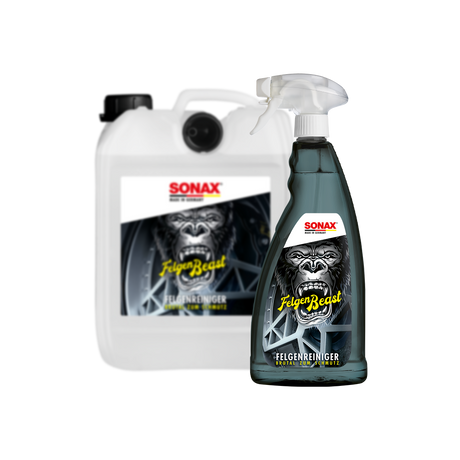
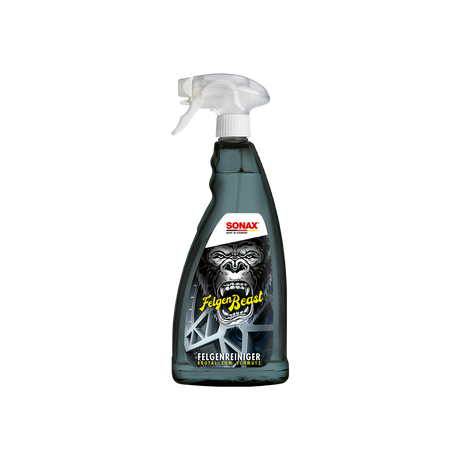
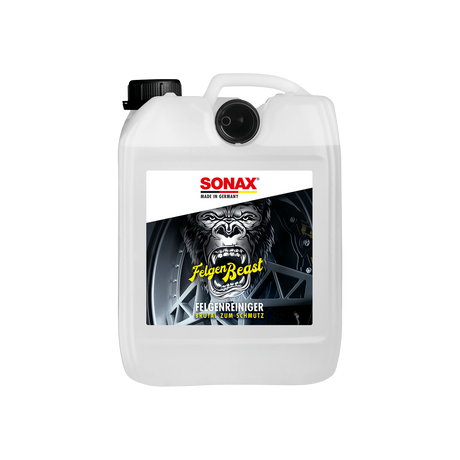
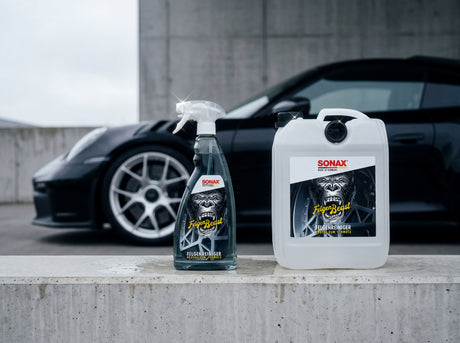
The 20-litre canister only pays off with heavy day-in-day-out work. Detailers with high daily throughput, rental-car fleet cleaning, hauliers running their own fleet care. For the keen hobby detailer, Awh is usually overkill. Here pH-neutral wheel cleaners like Mwc, Reactive Wheel Cleaner or Sonax FelgenBeast are the more honest choice.
The one trick the manufacturer doesn't push hard: Awh doubles as a first-rate tyre cleaner. Modern rubber compounds bloom antioxidants and go brownish over time, plus old tyre-dressing residue sticks in the pores.
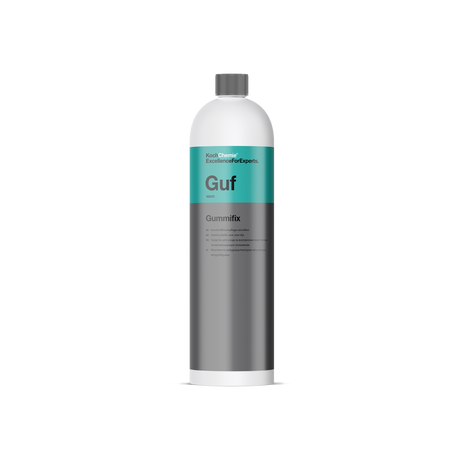
pH-neutral wheel cleaners can't shift that grease-and-rubber-heavy layer. Awh 1:5 lifts both in seconds. You clean wheel and tyre sidewall in the same spray pass and save yourself a separate tire cleaner. Seal the tyre afterwards with a deep-black dressing like Gummifix "Guf" and you've got the wheel workflow done in two steps and under ten minutes a car.

Not sure about Koch-Chemie Alkali Wheel Cleaner "Awh" Wheel Cleaner (alkaline)? Get it explained:
Koch-Chemie Alkali Wheel Cleaner "Awh" is a highly alkaline wheel cleaner with a pH of 14. It removes brake dust, road film, and tire rubber residue by saponifying the dirt matrix rather than through iron bonding. Fast-separating according to ÖNORM 5106, low-foaming formulation, designed for workshop and detailer use in 5- and 20-liter containers.
Manufacturer recommendation is 1:2 to 1:10. In practice, 1:5 has established itself as an all-round dilution: 1 part concentrate to 5 parts water. For weekly maintenance, 1:10 is sufficient, while for extreme crusts on workshop vehicles, 1:2 can be used. With a 1:5 ratio, 5 liters of concentrate produce a full 30 liters of ready-to-use solution, which is enough for about 150 complete vehicles.
Awh is a degreaser (pH 14), Mwc is a pH-neutral iron indicator (pH 5.5). Awh attacks the greasy dirt matrix, while Mwc targets the iron particles themselves. Use only Mwc on sensitive rims (polished, anodized, chrome). For baked-on brake dust on standard rims, a 1-2 punch is effective: first Awh, then Mwc.
Not suitable for raw or high-gloss polished aluminum, anodized rims, magnesium rims, uncoated forged rims, and chrome. Also, do not apply to hot rims immediately after driving. On these surfaces, the potassium hydroxide causes alkaline corrosion, resulting in milky, deeply etched spots that can only be reversed by professional polishing.
Applying it to hot or dry rims. Hot brake discs radiate more than 200 degrees; the water in the dilution evaporates immediately, leaving concentrated potassium hydroxide on the finish. Allow at least 15 minutes for cooling, then pre-rinse completely with cold water. Also, avoid letting it dry during the dwell time; a short second pass is better than waiting longer.
With the standard 1:5 dilution, 5 liters of concentrate produce 30 liters of ready-to-use solution. Detailers calculate about 200 ml of ready-to-use mixture per vehicle. A 5-liter canister is therefore sufficient for about 150 complete vehicles. The price per liter drops further with the 20-liter container, but this is only worthwhile for high daily throughput in workshops or detailing shops.
The rim must be cool. Wait at least 15 minutes after stopping; ideally, work in the shade. If Awh comes into contact with hot brake discs, the water content in the dilution will evaporate in seconds, and the concentrated potassium hydroxide will eat into the clear coat. Before the first spray, wet the entire rim completely with cold water.
The dilution ratio depends on the degree of soiling. 1:10 is sufficient for weekly maintenance, 1:5 is the all-around setting for normal brake dust after two to four weeks of driving, and 1:2 remains reserved for extreme crusts on workshop vehicles. Pump sprayers with a foam nozzle, such as the Koch-Chemie Foamer Bottle or an iK Foam sprayer, apply the solution as a sticky wet foam that adheres vertically to the rim well.
Dwell time: 1 to 3 minutes. On rougher rims, distribute briefly with a soft wheel brush, do not scrub. For tougher spots, perform a second short pass instead of extending the dwell time. Awh relies on chemistry rather than reaction time. Avoid letting it dry.
Rinse with a powerful cold high-pressure jet from top to bottom until the foamy veil has completely run off. Awh can be used directly on the tire sidewalls as well, removing brown antioxidant blooming in the process.
Notes: Not suitable for raw, high-gloss polished or anodized aluminum, magnesium, uncoated forged wheels, and chrome. If unsure about the rim surface, test on an inconspicuous area or switch to the pH-neutral Magic Wheel Cleaner "Mwc". Personal protective equipment is mandatory for professional use: nitrile gloves and safety goggles. In case of skin contact, rinse off thoroughly with plenty of water. Store frost-free between 5 and 30 degrees; use within 24 months after opening.
Safety information for Koch-Chemie Alkali Wheel Cleaner "Awh" Wheel Cleaner (alkaline)
For business customers only
This product, marked “For business customers only”, is not packaged, declared, registered and certified for private customers under German law. It may only be purchased by business buyers and is approved for professional users only. Please enter your VAT identification number in the cart. On request, we will tell you whether, and in which pack sizes, the product is approved for private customers.
Material composition
Hexyl D-glucoside (CAS 54549-24-5, EC 259-217-6) — 5 – < 10 %, Potassium hydroxide (CAS 1310-58-3, EC 215-181-3) — 1 – < 5 %, 2-Propylheptanol, ethoxylated (CAS 160875-66-1) — 1 – < 3 %, and Detergents Regulation (EC) No 648/2004: 5 % or over but less than 15 % phosphonates, non-ionic surfactants
Danger

Corrosive
| May be corrosive to metals. | H290 |
| Causes severe skin burns and eye damage. | H314 |
| Do not breathe dust/fume/gas/mist/vapours/spray. | P260 |
| Wear protective gloves/protective clothing/eye protection/face protection. | P280 |
| IF SWALLOWED: Rinse mouth. Do NOT induce vomiting. | P301+P330+P331 |
| IF ON SKIN (or hair): Take off immediately all contaminated clothing. Rinse skin with water [or shower]. | P303+P361+P353 |
| IF IN EYES: Rinse cautiously with water for several minutes. Remove contact lenses, if present and easy to do. Continue rinsing. | P305+P351+P338 |
| Immediately call a POISON CENTER/doctor. | P310 |
| Absorb spillage to prevent material damage. | P390 |
VOC content
0% — proportion of volatile organic compounds.
Downloads
Download safety data sheet
This product information is intended only as non-binding advice. No liability on our part can be derived from it. Please check whether the product is suitable for your application. Test for suitability and compatibility before use. We are happy to advise you.
Questions about this information?
Contact
Koch‑Chemie GmbH
Einsteinstr. 42, 59423 Unna, Deutschland
+492303986700
info@koch-chemie.com
koch-chemie.com
Choose from many payment methods such as PayPal, Klarna, Apple Pay, Mastercard or Visa and benefit from pay later and instalment options. Your payment details are always processed securely. Questions about payment?
Your order reaches you from 8,90 € in 1-4 days with FedEx, DPD or SDA. Questions about shipping?


Koch-Chemie
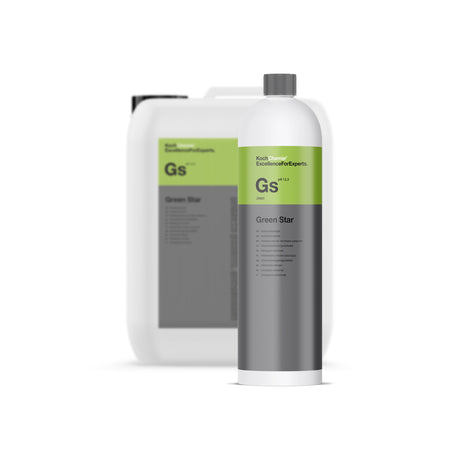
Green Star "Gs" Universal Cleaner
Highly alkaline APC concentrate for workshops, engine bays and lifts


Koch-Chemie
Spray Head "Star" (28/400) CHS-3AN by Canyon
Chemical spray head for 28/400 bottles with stepless nozzle
Koch-Chemie
Top Star "Ts" Interior Plastic Care
Silicone-free Plastic Care with UV Protection and Silk-Matte Finish
Koch-Chemie
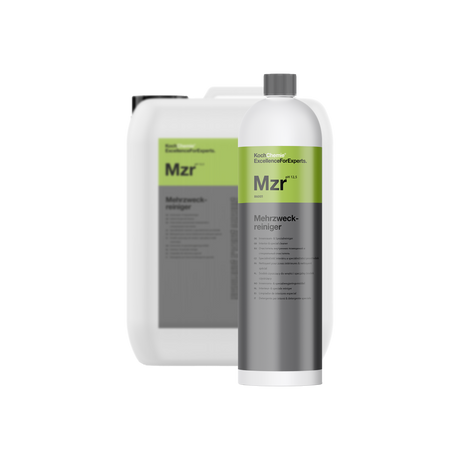
Multi-Purpose Cleaner "Mzr" All-Purpose Cleaner
Alkaline cleaner concentrate with pH 12.5 and Daimler approval
Koch-Chemie
Vorreiniger B "Vb" Pre-Cleaner
Alkaline pre-cleaner for car and truck pre-washing, VDA-compliant
Koch-Chemie
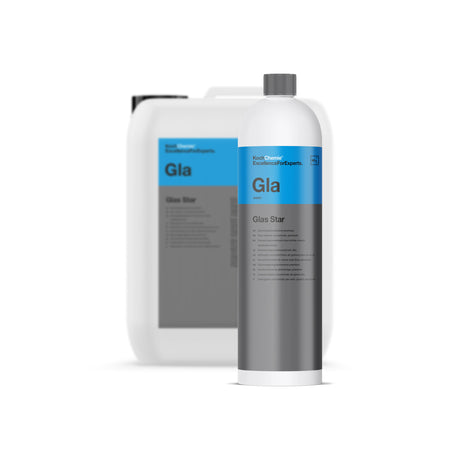
Glas Star "Gla" Glass Cleaner Concentrate
Concentrated alcohol-based glass cleaner with Daimler approval
Koch-Chemie
Cleans thoroughly and gently, preserves the shine of the paint surface
Koch-Chemie
Reactive Rust Remover "Rrr" iron fallout remover
Maximum cleaning performance for flawless results without compromise
Koch-Chemie
Teerwäsche A "Tea" Bitumen & Tar Remover
Perfect bitumen and tar removers for a flawless finish
Koch-Chemie
Leather Star "Ls" Leather Care
Ready-to-use leather care emulsion with active UV blockers
Koch-Chemie
Gummifix "Guf" rubber and plastic care
Silicone-free rubber and plastic care for non-slip floor mats


Koch-Chemie
Magic Wheel Cleaner "Mwc" Wheel Cleaner
Acid-free wheel cleaner with color change for daily workshop use
Koch-Chemie
Magic Wheel Cleaner "Mwc" Wheel Cleaner
Acid-free wheel cleaner with color change for daily workshop use
SONAX
Acid-free wheel cleaner with color change for all rim types
Koch-Chemie
Felgenreiniger extrem "Fe" wheel cleaner
Hydrochloric acid pro wheel cleaner for baked-on brake dust
TUGA Chemie
Alu-Teufel "Spezial"® (Green) Wheel Cleaner
pH-neutral wheel cleaner gel with active indicator for all rims


Koch-Chemie
"ReactiveWheelCleaner" Wheel Cleaner
Revolutionize rim care with this high-quality cleaner
Koch-Chemie
Alkali Wheel Cleaner "Awh" Wheel Cleaner (alkaline)
Highly alkaline wheel cleaner concentrate for daily pro use
TUGA Chemie
Aluminium-Teufel® (Red) Wheel Cleaner
Acidic wheel cleaner for extremely baked-on brake dust
Koch-Chemie
Felgenblitz säurefrei "Fb" wheel cleaner
Effective acid-free wheel cleaner with color change
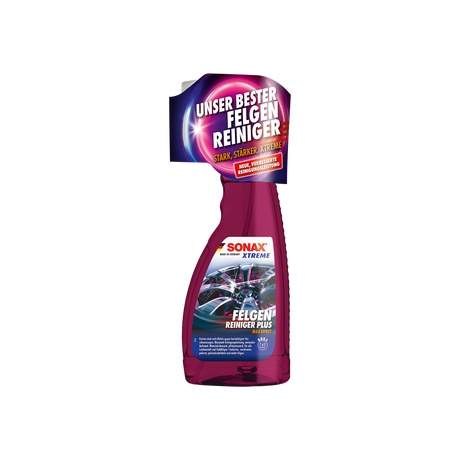
SONAX
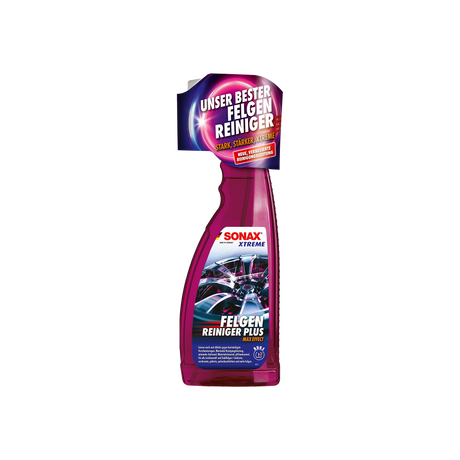
Wheel Cleaner PLUS — color-changing, for all wheel types, TPMS
Koch-Chemie
Triple Acid Star "Ta" Wheel Cleaner
D-CON
"V4" Wheelcleaner & De-Ironizer Wheel Cleaner
Highly effective rim cleaner with lavender scent for all surfaces
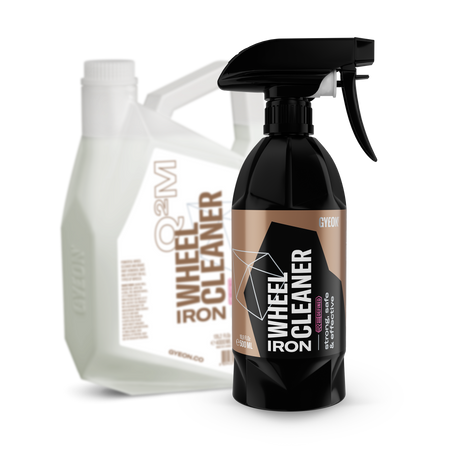


GYEON
Q²M Iron WheelCleaner (REDEFINED) Wheel Cleaner
Reactive Wheel Cleaner – Brake Dust & Rust Film Chemically Dissolved


Dr. Wack "P21S"
Maximum cleaning power for all rims


Meguiars
Safely remove brake dust & road grime — no scrubbing


Soft99
Soft99 Iron Terminator Wheel Cleaner
Innovative rim cleaner for deep cleaning
Koch-Chemie × THE FINISHER
THE FINISHER "WheelKing" Wheel Cleaner
Powerful acid-free wheel cleaner with shine and beading effect


Dr. Wack "P21S"
P21S "POWER GEL" Wheel Cleaner
Acid-free wheel cleaning gel with colour indicator and cling time
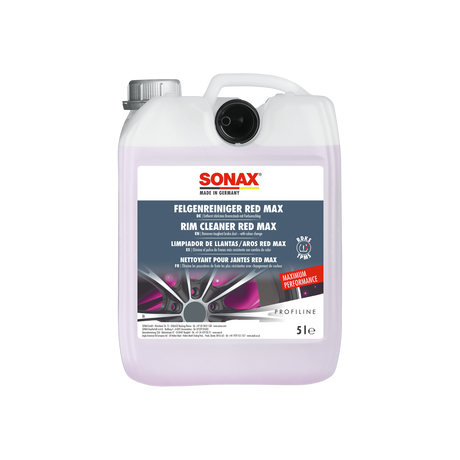
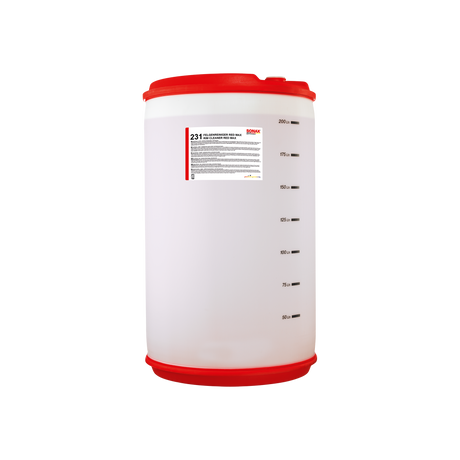
SONAX
PROFILINE FelgenReiniger Red Max wheel cleaner
Wheel Cleaner Red Max — Acidic Professional Wheel Cleaner
NAP Care
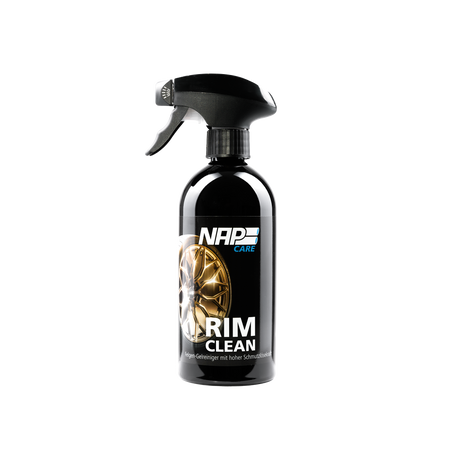
NAP Care "RIM-CLEAN" Wheel Gel Cleaner and Iron Fallout Remover
Effective wheel cleaner for shiny and clean rims
Soft99
Digloss Kamitore Wheel and Tire Cleaner Felgenreiniger
Wheel cleaner that deeply cleans and protects.
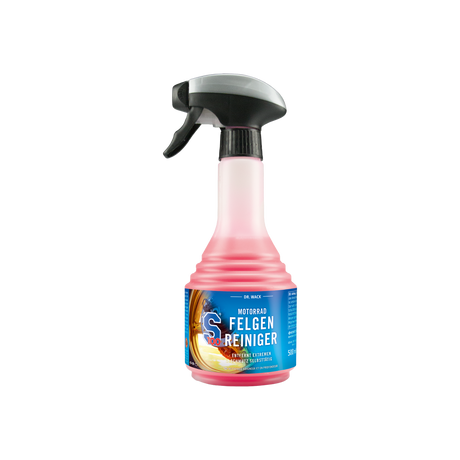
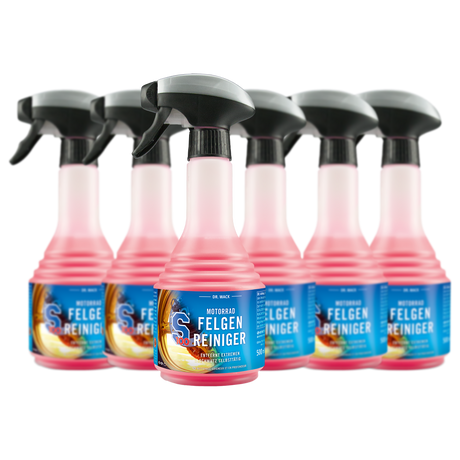
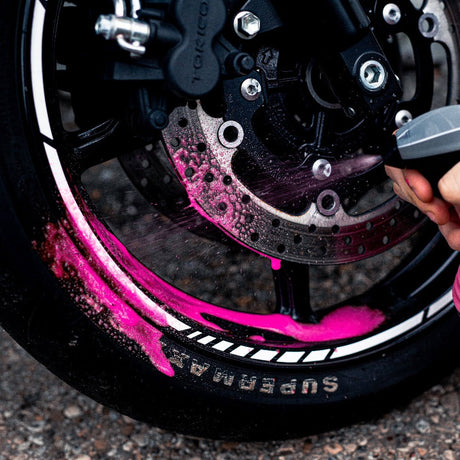
Dr. Wack "S100"
"S100" Motorcycle Wheel Cleaner for Motorbikes
Effective wheel cleaner for sparkling clean motorcycle wheels

Meguiars
Ultimate Waterless "Wheel and Tire" Dry Wash Detailer
Waterless rim cleaning and tire care in one product
NIGRIN
Acid-free wheel cleaner gel with colour change for all wheel types
TUGA Chemie
Biker's Felgen-Teufel® wheel cleaner for "motorcycles"
Acid-Free Motorcycle Wheel Cleaner with Chelating Agent Indicator
Daniel von Detailing1 |

Daniel von Detailing1 |

Daniel von Detailing1 |

Daniel von Detailing1 |

Daniel von Detailing1 |

Jasper von Detailing1 |

Daniel von Detailing1 |

Daniel von Detailing1 |

Daniel von Detailing1 |

Jasper von Detailing1 |

Jasper von Detailing1 |

Daniel von Detailing1 |


